Consultation
We respond within 15 minutes
Section 1: Search Transformation and Interface
Question: What is the AI Overview layer (formerly SGE) in Google, and how is it connected to classic search results?
Answer: AI Overview is an artificial intelligence layer powered by the Gemini model that generates a synthesized response above the organic search results. It does not index the internet from scratch – it pulls data from the top 10 classic organic results. Thus, traditional SEO serves as the foundation: without strong positions in the top 10, appearing in the AI block is practically impossible.
Question: What is the “zero-click” phenomenon in the AI era, and how does it affect traffic?
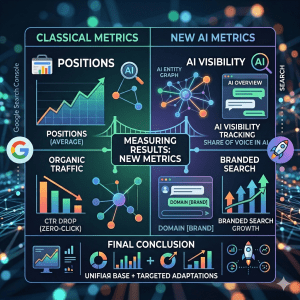
Answer: This is a situation where a user gets a complete answer directly on the search results page and does not click through to a website. With the rollout of AI Overview, the click-through rate (CTR) for informational queries dropped by 40-60%. However, this is not the death of SEO for websites, but rather a shift in the user’s entry point: appearing in AI responses drives brand awareness and branded search growth.
Question: For which types of search queries does Google most frequently display AI responses, and for which does it rarely do so?
Answer: AI is triggered for informational queries (how, why, what is), comparisons (X vs Y), research topics, and complex multi-part questions. AI is rarely triggered for transactional queries (buy, price), navigational queries (searching for a specific website), branded queries, and local commercial queries (restaurant near me).
Section 2: The Ecosystem of Alternative Search Engines
Question: How does Perplexity’s ranking logic fundamentally differ from Google’s?
Answer: Perplexity does not depend on Google’s index and uses its own crawler (PerplexityBot). The system focuses on the freshness, relevance, and citation frequency of data. It gives clear priority to materials with precise, recent publication dates, academic sources, research papers, and original industry statistics.
Question: What specific nuance should be considered when optimizing for ChatGPT Search?
Answer: Microsoft Bing serves as the core index for ChatGPT Search, on top of which OpenAI applies its own re-ranking layer. To gain visibility in ChatGPT, it is critical to work with Bing Webmaster Tools, optimize metadata, and account for social signals (especially LinkedIn for B2B). It is also necessary to explicitly allow the GPTBot crawler in the robots.txt file.
Section 3: Technical SEO and Website Requirements
Question: What critical error in the robots.txt file can make a website invisible to AI search engines?
Answer: Using outdated directives like Disallow: / for unknown user-agents or relying on overly strict whitelisting. In 2026, you must explicitly grant access to AI crawlers such as GPTBot, ClaudeBot, PerplexityBot, GoogleOther, and Applebot.
Question: How does development architecture (specifically Next.js/React) affect AI bot crawling?
Answer: AI crawlers (like PerplexityBot) handle client-side JavaScript much worse than the classic Googlebot, or do not process it at all. Therefore, using SSR (Server-Side Rendering) or SSG (Static Site Generation) has become a strict technical requirement. If content is rendered only on the client side (CSR), the AI bot will see a blank page.
Question: How has Google’s approach to evaluating Core Web Vitals (CWV) changed since March 2026?
Answer: Google shifted from evaluating individual URLs to aggregating metrics at the entire domain level. Slow, unoptimized pages in any section of a website now negatively impact the overall domain score. Optimization must be carried out centrally at the template level (e.g., configuring image and font properties in Next.js).
Section 4: On-Page Content Optimization for AI
Question: What does the shift from “keywords” to “semantic entities” mean?
Answer: Algorithms no longer look for simple text matches. They map queries against the Knowledge Graph (billions of entities: brands, concepts, people) and evaluate how comprehensively and deeply a page covers the entire semantic field and related concepts, rather than just containing isolated keywords.
Question: What are the main rules for structuring text so an LLM can easily extract an answer from it?
Answer: Use the inverted pyramid principle: a clear, direct answer is provided in the very first sentence of a paragraph, followed by details. Format H2/H3 headings as specific questions or statements. Format definitions clearly using a colon (Term: definition). Use tables to compare characteristics.
Question: What is the “factual density” of content, and how does it affect AI ranking?
Answer: It is the ratio of useful, verifiable information to the total volume of text. AI models penalize informational fluff (wordiness, cookie-cutter intros like “In today’s world…”, and repetitions). Text must be highly concise, with every paragraph delivering new facts.
Section 5: Authority (EEAT) and Link Building
Question: How do algorithms technically measure EEAT parameters in 2026?
Answer: EEAT does not measure the text itself, but rather the authority of the entity (author or brand) within the Knowledge Graph. This is built on external, verifiable signals: mentions on authoritative resources, connections via sameAs markup, the entity’s presence in Wikipedia/Wikidata, and the author’s profiles on LinkedIn or Google Scholar.
Question: Why is using the sameAs property in Schema.org microdata so important?
Answer: The sameAs array of links in Organization or Person schemas serves as a technical verification link for search engines: it explicitly points out that the organization on the website is the exact same entity as the company profile on LinkedIn, Wikidata, or Crunchbase. This reinforces the entity’s weight in the Knowledge Graph.
Question: How has the role of backlinks and brand mentions (Digital PR) changed?
Answer: Links still pass classic PageRank (as confirmed by Google leaks). However, within the EEAT framework, implied links (unlinked brand name mentions on authoritative resources, like Forbes, without an active hyperlink) have gained massive importance. Google has learned to associate such mentions with the brand entity and use them as a trust signal.
Section 6: Strategic Conclusion
Question: Do you need to create separate SEO strategies for each AI search engine in 2026?
Answer: No, the most effective strategy is a single, multi-layered system. The foundational 80% of requirements (technical hygiene, speed, SSR, EEAT, deep and structured content) are equally important for all platforms. Individual engines require only fine-tuning: Bing Webmaster Tools for ChatGPT, focusing on data freshness for Perplexity, and Knowledge Graph optimization for Google.
Maryan Polyak
Consultation
We respond within 15 minutes