


Consultation
We respond within 15 minutes
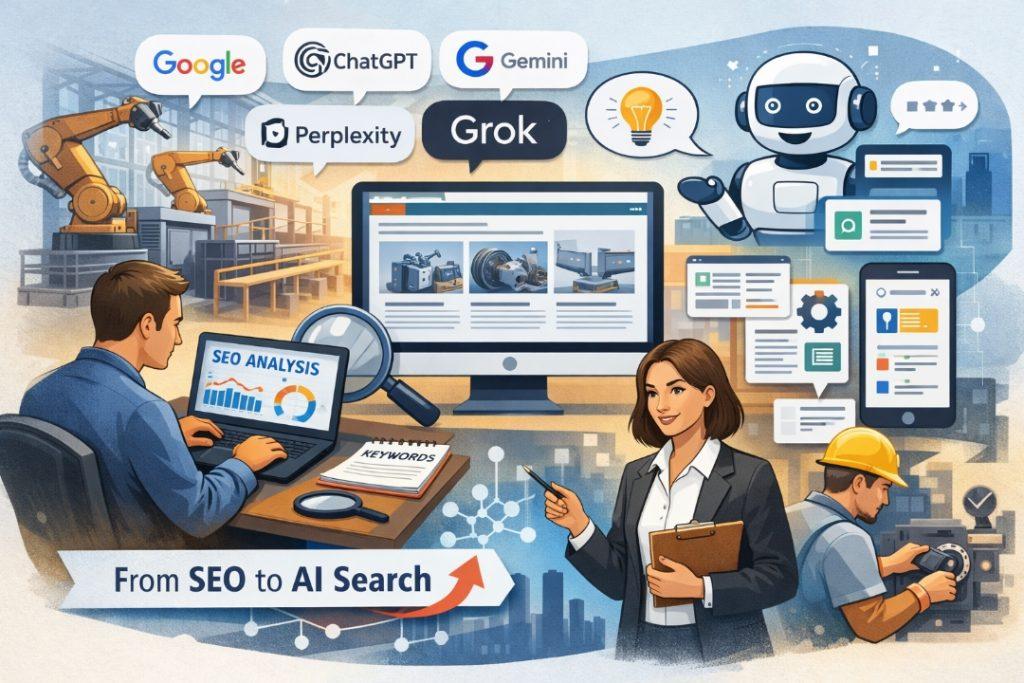
Over the last two years, the familiar goal of “ranking a website in Google” has gained a new dimension. People are increasingly seeking recommendations not only from search engines but also from ChatGPT, Gemini, Perplexity, Grok, and DeepSeek. For manufacturing companies, this means that visibility is no longer required in just one ecosystem but across multiple platforms simultaneously. The core principles remain the same, but the strategy now needs to be expanded.
The following analysis framework is best approached in the order presented below.
Understanding the Business and Market
Before conducting any technical analysis, it is essential to establish a clear understanding of the business fundamentals. What exactly does the company manufacture? Who are the target customers? Are products sold directly or through distributors? What is the typical sales cycle?
Without answering these questions, every subsequent stage becomes guesswork rather than strategy.
Competitor Analysis
This stage involves more than reviewing competitors’ websites and advertising campaigns. It also includes examining which companies AI assistants currently recommend when users ask questions such as “Who manufactures this type of product?” or “Where can I order this equipment?”
This can be tested manually by asking similar questions across multiple AI platforms. If competitors are being mentioned while your company is absent, this represents a clear visibility gap that can be addressed.
SEO and Semantic Analysis
Traditional keyword research, search volume analysis, keyword clustering, and website structure remain the foundation of online visibility.
However, one important factor has emerged. AI systems are significantly better at extracting and citing content that provides direct answers, technical specifications, comparison tables, and structured information. Vague marketing language without measurable data is rarely referenced by AI-generated responses.
Website Architecture and Product Catalog Structure
For manufacturers, a website should include a well-organized product catalog with logical filtering options, dedicated pages for production capabilities and certifications, and a B2B inquiry process rather than a standard e-commerce shopping cart.
A clear site structure is important for two reasons. It helps traditional search engines understand and rank the website, while also enabling AI systems to accurately identify what the company manufactures and offers.
Content and Demonstrated Expertise
Technical product descriptions, industry case studies, application examples, and articles about manufacturing processes serve two important purposes.
For potential customers, they answer questions and reduce uncertainty before making contact. For search engines and AI systems, they demonstrate genuine expertise and authority rather than simply presenting sales-oriented content.
Technical SEO
This includes all the standard technical requirements:
- Website speed optimization
- Proper indexing of large product catalogs
- Logical URL structure
- Schema.org structured data for products and organizations
Additional Considerations for AI Systems
A newer addition is the llms.txt file. Similar to robots.txt, it provides guidance to AI systems regarding how website content may be accessed and interpreted when generating responses.
It is also important to understand that not all AI systems operate in the same way.
Search Engines with AI Overviews
Platforms such as Google AI Overviews and Bing Copilot rely heavily on live search results. For these systems, traditional SEO combined with structured data often produces results relatively quickly.
AI Systems with Live Search
Platforms such as Perplexity and ChatGPT with browsing capabilities evaluate sources in real time. In this environment, it is important for company information to appear across multiple authoritative sources rather than existing solely on the company website.
Models Without Live Search
AI systems that do not continuously access the internet rely on information contained within their training data. For these models, brand mentions across the broader web become increasingly important, and visibility gains are typically measured over months or years rather than weeks.
Advertising and Analytics
Google Ads and Meta advertising can be valuable at the beginning of a project not only for generating leads but also for validating market demand.
Advertising data helps answer important questions:
- Which regions respond most actively?
- What is the average cost per click in the industry?
- Which search queries actually generate qualified leads?
These insights later inform both the SEO strategy and the content development plan.
Reputation and Brand Mentions
Customer reviews, quality certifications, client case studies, and a Google Business Profile (when a physical office or manufacturing facility exists) all contribute to trust and credibility.
This area is important not only for human visitors but also for AI systems. Models without live search capabilities often form their understanding of a company based on references and mentions found across third-party websites and industry resources.
Conclusion
The approach to online visibility has not fundamentally changed—it has expanded.
The same principles that have guided search engine optimization for the past two decades now apply to optimization for AI assistants and large language models. Companies that build their websites and content strategies for both traditional search engines and AI-driven platforms will achieve visibility across multiple discovery channels rather than relying on a single source of traffic.
Maryan Polyak
SEO Expert. Web Developer. Digital Growth Strategies for Manufacturing Companies.
Consultation
We respond within 15 minutes


