SEO in the Age of AI Search: What Has Changed in Algorithms and How to Adapt Your Strategy

SEO in the Age of AI Search: What Has Changed in Algorithms and How to Adapt Your Strategy

Consultation

We respond within 15 minutes

1. Introduction: search engines have mutated

Every time a new technology appears, the industry begins to panic with predictions of the end of the old world. It was the same with social networks — “they will kill SEO.” It was the same with voice search — “no one will type anymore.” The same thing is happening now with AI: “ChatGPT has killed Google.”

Reality, as always, is more complex.

Google processes around 8.5 billion queries per day in 2026. This is more than in 2023. People have not stopped Googling — they have changed their expectations of results. The user still enters a query into the search bar. But they want an answer, not a list of links from which they must assemble information themselves.

Google responded to this not by replacing its algorithm, but by adding a new layer on top of it — AI Overview (formerly SGE). This is a synthesized answer that appears above organic results for certain types of queries. Below it is the same classic organic layer — the same ten blue links.

The key understanding here is the following: the classic search algorithm has not gone anywhere — it has become the foundation for the AI layer. AI Overview does not index the internet from scratch. It takes pages from the top 10 organic results and synthesizes an answer from them. This means that without strong positions in classic SEO, it is practically impossible to appear in an AI citation.

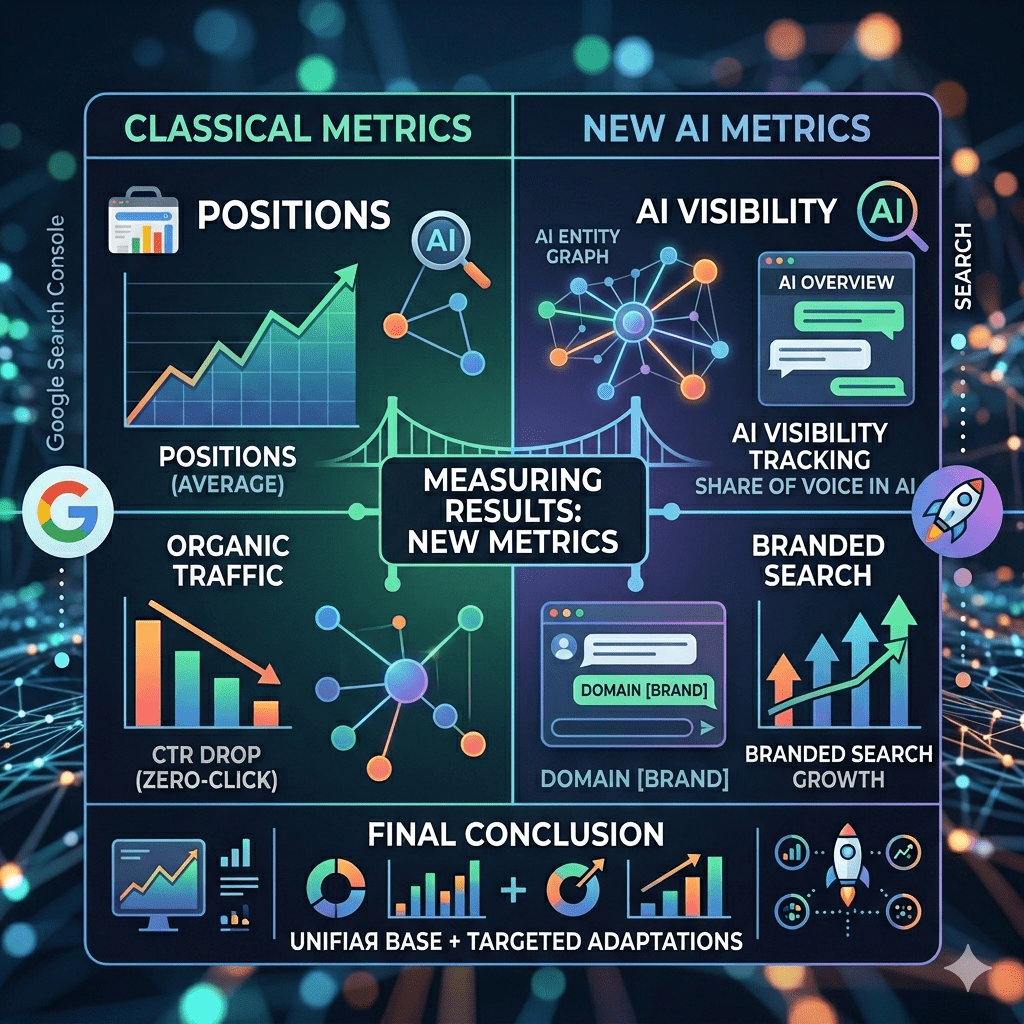
What has really changed is the interface of result consumption and, as a consequence, user behavior. Part of the audience now receives an answer directly on the search page and does not go to the site at all. This is the zero-click phenomenon, which already existed — with Featured Snippets, Knowledge Panel, Local Pack — but now it has scaled significantly. According to several studies, for informational queries the click-through rate dropped by 40–60% after AI Overview appeared on specific SERPs.

But this is not an obituary for SEO. It is a change in the user entry point into the funnel. A site that appears in an AI citation as a source receives brand mentions, growth in branded search, and part of the traffic from users who want to go deeper. A site that is not present either in organic results or in the AI layer — is simply invisible.

In parallel with Google, independent AI search engines are developing: Perplexity, ChatGPT Search, Copilot. Their audience is still not comparable in size, but it is growing and has a characteristic profile — technically skilled users, researchers, professionals. For B2B and highly competitive niches this is already a significant channel.

In summary: the search ecosystem in 2026 is not a replacement of old with new, but a multi-layer system where classic SEO remains the foundation, the AI layer inside Google is a new priority interface, and independent AI engines are a growing additional channel.


2. Two parallel worlds: classic SERP vs AI layer

To build a strategy, you need to clearly understand the mechanics — when Google shows AI Overview, when it does not, and how these two worlds interact.

Which queries trigger AI responses

Google does not show AI Overview for all queries. The pattern is quite clear:

Trigger AI Overview:
Informational queries with question intent (“how it works”, “what is”, “why”, “X vs Y comparison”)
Research-intent queries (“best ways”, “how to choose”)
Complex multi-component questions where the answer requires synthesis from multiple sources

Do not trigger or rarely trigger:
Transactional queries (“buy”, “price”, “order”) — here Google shows Shopping, Maps, organic results
Navigational queries (“company X website”, “login”)
Local queries with clear commercial intent (“restaurant near me”, “repair shop nearby”)
Branded queries

This is strategically important: if your business lives on transactional traffic — the direct impact of AI Overview on your CTR is minimal. If you work with informational content or top-of-funnel — the impact is significant.

AI Overview mechanism: where content comes from

AI Overview is not a separate index. Google uses its existing search index, selects relevant pages from top results, and passes them to its language model (Gemini) for answer synthesis. Sources are shown as links next to the answer.

From this comes a practical conclusion: appearing in AI Overview without presence in classic organic results for the query is extremely unlikely. This is not two independent algorithms — it is one algorithm with two result display interfaces.

At the same time, correlation is not linear: a page in position #1 does not guarantee inclusion in an AI citation, and a page in position #7 may be cited if its content better answers a specific aspect of the query. The AI model optimizes for answer quality, not ranking position.

Position #1 vs AI citation: different optimization goals

Classic SEO optimizes a page so that the algorithm evaluates it as the most relevant document for the query. Criteria — link profile, E-E-A-T, technical factors, behavioral signals.

AI citation optimizes content so that the language model can extract a clear, verifiable answer to a specific question. These are different tasks.

A page may have high domain authority, a strong backlink profile, and rank first — but if its content is written like a “wall of text without structure,” the AI model will not be able to extract a clear answer and will prefer a less authoritative but structurally clean page.

Practically, this means the need to work on two levels simultaneously: at the level of document authority (classic SEO) and at the level of answer extractability (structure, direct formulations, factual density).

Independent AI search engines: a separate ecosystem

Perplexity, ChatGPT Search, and Copilot are not overlays on Google, but independent systems with their own crawlers and their own logic for ranking sources. What unites them is one thing: they all evaluate source authority, but define authority differently.

Perplexity focuses on freshness and citation frequency — it actively crawls news sources and academic publications. ChatGPT Search uses Bing as its base index with its own reranking layer. This means that sites with strong presence in Bing index have an advantage — historically an underestimated channel for many SEO specialists.

In terms of audience, these platforms are still not comparable to Google, but demographically this is a high-value segment. Strategically — a unified technical and content base covers the requirements of all platforms with only minor adaptations for each, which will be discussed in section 3.


3. Optimization for different AI engines — yes, this is already real

The analogy with Yandex/Google is appropriate and accurate. At one time SEO specialists built separate strategies for two search engines with different ranking logic — different link weighting, different behavior factors, different indexing speed. Now the situation is structurally similar, but with an important difference: AI engines differ not so much in ranking algorithm as in data sources and logic of source selection for citation.

Let’s consider each engine separately.

Google AI Overview

Data source — Google’s own search index. This means all classic ranking signals work as input data: PageRank, E-E-A-T, technical factors, behavioral signals. Gemini receives an already filtered pool of relevant pages and selects sources from it for answer synthesis.

Specific factors for AI Overview: structured Schema.org data directly affects how Google identifies entities on a page. Pages with clear Organization, Person, Article, FAQPage markup get an advantage in source selection. Google Knowledge Graph is a key element: if your brand or author is represented as a verified entity in the knowledge graph, this significantly increases citation probability.

Practically: strategy for Google AI Overview is enhanced classic SEO plus entity graph work. There is no separate algorithm, but there is an additional layer of requirements for structure and extractability.

Perplexity

A fundamentally different architecture. Perplexity uses its own crawler and does not depend on Google index. This means a site can rank first in Google — and still be invisible to Perplexity if its crawler has not reached the page or considers it insufficiently authoritative by its criteria.

Perplexity logic — citation and freshness. The system prefers sources cited by other authoritative sources and materials with a recent publication or update date. Academic sources, industry publications, research with real data — all of this falls into the priority zone.

For Perplexity it is critical: having PerplexityBot allowed in robots.txt, regular content updates with explicit dates, links from authoritative industry platforms, and presence of original data or research — this is exactly what the system actively cites.

ChatGPT Search

Microsoft Bing is the main index for ChatGPT Search, on top of which OpenAI applies its own reranking layer. This creates a specific situation: Bing index is historically less competitive than Google — many sites with strong Google rankings have weak presence in Bing simply because they never focused on it.

Practically: verification and optimization in Bing Webmaster Tools is now an underrated lever for ChatGPT Search visibility. Bing has its nuances — it reads metadata better, is more conservative in link profile evaluation, and more actively uses social signals (LinkedIn is especially important for B2B topics).

OpenAI’s own crawler — GPTBot — is also active and used for model training and data updates. Allowing GPTBot in robots.txt and having high-quality content is a long-term investment in presence in the OpenAI ecosystem.

Claude / Anthropic

Anthropic uses its own ClaudeBot crawler for data collection. Claude traditionally prefers long, exhaustive materials with high factual density — guides, technical documentation, detailed analytical articles. Content that answers the question fully in one place, without needing to go elsewhere.

Unified base vs separate strategies

The practical answer: a single technical and content base covers 80% of all platform requirements. Fast site, structured content, E-E-A-T signals, structured data, crawler permissions — this works everywhere.

Adaptations by specificity:
For Perplexity — focus on freshness and original data
For ChatGPT Search — work with Bing Webmaster Tools
For Google AI Overview — work with Knowledge Graph and entity schema
For Claude — long exhaustive format

This is not four separate strategies. It is one strategy with four tuning points.

4. Technical criteria: what AI crawlers scan

Technical SEO in 2026 has added a new dimension — in addition to the classic Googlebot, there is now an ecosystem of AI crawlers, each with its own crawling logic and its own requirements for content accessibility.

Crawlers and robots.txt

The current list of AI agents that must be considered in robots.txt:

GPTBot – OpenAI / ChatGPT Search
ClaudeBot – Anthropic
PerplexityBot – Perplexity
GoogleOther – Google AI (separate from Googlebot)
Applebot – Apple Intelligence
YouBot – You.com

A critically important point: many websites configured several years ago have lines in robots.txt such as Disallow: / for unknown agents or use a whitelist approach. In this case all AI crawlers are blocked by default — the site exists for Google, but is invisible to the entire AI ecosystem.

Checking and explicitly allowing each agent is the first technical step of an AI search audit.

JavaScript rendering — a critical point

Classic Googlebot has long been able to render JavaScript, although with a delay. AI crawlers are heterogeneous. Perplexity Bot and several other agents handle JS significantly worse or do not handle it at all. If page content is generated by client-side JavaScript — a significant portion of AI crawlers sees an empty page.

For Next.js developers this is a direct architectural requirement: SSR (Server-Side Rendering) or SSG (Static Site Generation) is not just about improving LCP — it is a requirement for content accessibility for AI crawlers. A site built on pure client-side React with content loaded via API after page load is technically invisible to part of the AI ecosystem.

Practical check: disable JavaScript in the browser and open the page. If the main content disappears — AI crawlers will have problems with it.

Structured Data as a direct feed for AI

Schema.org markup in 2026 serves a dual function: classic rich snippets in SERP plus a direct feed for entity recognition in AI systems. The difference is how AI uses this data — not for display, but for building semantic relationships between entities.

Priority markup types for AI visibility:

Organization / LocalBusiness — sameAs links to verified profiles (Wikipedia, Wikidata, LinkedIn, Crunchbase) build the entity graph of your brand. The more authoritative points confirm the existence of the entity — the higher the trust of the AI system.

Person — for content authors. Author schema with sameAs links to LinkedIn, Google Scholar, industry profiles. AI verifies author expertise through the graph, not through article text.

Article / BlogPosting — with explicit datePublished and dateModified. Content freshness is one of the key signals for Perplexity and ChatGPT Search. A page without an explicit publication date loses this signal entirely.

FAQPage — structured questions and answers are directly extracted by AI models as ready-made answer units. This is one of the most effective formats for appearing in AI citations.

Core Web Vitals: holistic scoring from March 2026

Until March 2026, Google evaluated CWV at the level of individual URLs. The standard practice was to optimize the top 50 landing pages and ignore the rest. With the March 2026 update, this strategy stopped working.

Google moved to domain-level aggregation: the performance of the entire domain forms a single weighted score. High-traffic pages have more weight, but slow pages anywhere on the site contribute a negative signal to the aggregate. If 30% of indexed URLs fail LCP — this drags down the entire domain, including optimized pages.

Practical consequence: audits must cover the entire domain, not a sample. The tool is CrUX data in Google Search Console at origin level, not URL level. Optimization must be done at the template level: fixing one blog template fixes thousands of URLs at once.

Current thresholds and reality:

Metric | Good | Market reality
LCP | < 2.5s | 62% of mobile pages pass
INP | < 200ms | 57% of sites pass — the most failing metric
CLS | < 0.1 | highest pass rate

For the Next.js stack, specific optimization points: priority prop on hero images (removes lazy loading from LCP element), font-display: swap in next/font, explicit width/height on all media elements for CLS, minimization of work in main thread for INP via Server Components.

llms.txt — new standard or marketing?

In 2024–2025 an initiative appeared — llms.txt — a file in the root of the site with a structured description of content specifically for AI agents, analogous to sitemap.xml. Google officially stated that it does not use llms.txt as a ranking signal. Perplexity and several other systems declare support.

Practical position: implementing llms.txt is minimal effort with potential upside for non-Google AI engines. Not a priority, but reasonable hygiene.


5. On-Page in AI context: from keyword density to entity coverage

This is perhaps the most radical shift in on-page optimization in the last ten years. Not evolution — but a paradigm shift. Keyword density, LSI keywords, exact match in headings — all of this has not died, but has moved to the background. At the forefront is a concept that can be formulated as follows: a page must comprehensively cover a topic as a semantic entity, not just contain target keywords.

From keywords to semantic entities

Google Knowledge Graph contains billions of entities — people, places, organizations, concepts, products — and relationships between them. When a user enters a query, Google increasingly interprets it through the lens of entities, not text strings. “Best coffee” is not just three words, it is a query with entities: coffee as a product, local user context, intent to buy or find a place.

A page that covers a topic as an entity explicitly connects its content with these entities — through terminology, through schema, through links to authoritative sources, through mentions of related concepts. AI models, when analyzing a page, build an internal entity graph and evaluate the completeness of topic coverage.

Practically this means: before writing content, you need to define not only keywords, but also the semantic field of the topic — which related entities, concepts, questions must be covered on the page. Tools like Google NLP API or similar allow checking how the algorithm interprets entities on existing pages.

Content structure as navigation for AI parsing

A language model, when extracting a citation, does not read a page like a human — it looks for extractable answer units. Page structure determines how easily the model can find and extract the needed fragment.

Several concrete principles:

Direct answer at the beginning of the paragraph. The journalistic inverted pyramid — first the main point, then details — works perfectly for AI extraction. A paragraph that starts with context and reaches the answer at the end is poorly extracted. A paragraph that gives a clear answer in the first sentence and then expands it works well.

H2/H3 as questions or clear statements. A heading like “Technical aspects” is bad. A heading like “How loading speed affects ranking” or “Three technical factors critical for AI crawlers” is good. The model uses the heading as a label for the content under it.

Definitions in explicit format. When a page provides a definition of a concept, it is better to structure it: bold term, colon, definition. This is a standard pattern that models recognize as a definition of an entity.

Tables for comparisons. Tabular format is one of the best for AI extraction of structured data. Comparison of tools, metrics, characteristics in a table is extracted significantly more effectively than the same data in text form.

Thin content vs comprehensive: a turning point

There is a common misconception that “long content ranks better.” This is not entirely correct. More precisely: comprehensive content ranks better than superficial content, and comprehensive content is by definition longer.

The difference between long and comprehensive content is critical. An article of 4000 words that repeats the same ideas with different wording is long superficial content. It does not gain advantage. An article of 2500 words that covers the topic from multiple angles, answers related questions, and contains original data is comprehensive content. It gains advantage.

The metric to use instead of word count: topic coverage score — the percentage of semantically related questions on the topic that the page answers. Tools like Surfer SEO, Clearscope, or manual analysis via People Also Ask approximate this metric.

Update frequency as a signal

AI systems, especially Perplexity and ChatGPT Search, actively take content freshness into account. But “freshness” in AI context is not just publication date, it is verifiable information relevance.

A page published in 2022 and not updated since then, even with good rankings and strong backlink profile, loses to a fresher page when selecting a source for citation in an AI answer to a current query. Especially if the topic is subject to change — technology, legislation, market data.

Practice of leading SEO teams in 2026: a revision cycle for key pages once per quarter. Not rewriting — but updating data, adding current examples, correcting outdated statements with explicit dateModified updates in schema. This signals to crawlers that the content is actively maintained.

Factual density vs informational filler

One non-obvious shift: AI models, when evaluating source quality, consider the ratio of factual information to text volume. Content with a high share of introductory phrases, transitions, repetitions has low factual density. Content where each paragraph carries concrete information has high density.

This does not mean you should write in telegraphic style. It means that template introductions like “In the modern world SEO plays an important role…”, repeated conclusions, and padding content actively harm positioning as an AI citation source.

6. E-E-A-T as a Machine Signal

E-E-A-T – Experience, Expertise, Authoritativeness, Trustworthiness – has existed in Google documentation since 2018 and is regularly interpreted as something abstract: “write quality content,” “demonstrate expertise,” “build trust.” These are useless recommendations because they do not answer the question: how does the algorithm technically measure expertise?

In 2026, understanding of the E-E-A-T mechanism has become significantly clearer – largely thanks to leaks of internal Google documentation and patents that allow reconstruction of the system’s logic.

How Google technically measures authority

Google builds an entity graph – a graph of entities where each entity (brand, author, site, concept) has an authority weight formed from external signals. This is not PageRank for pages – it is authority of the entity as such.

For a brand/organization, the graph is built from:

  • The quantity and quality of mentions on authoritative domains
  • Presence of a Wikipedia/Wikidata entry
  • sameAs links in schema with verified profiles
  • Citations in news sources with high domain authority
  • Consistency – how consistently the entity is described across platforms

For an author, the graph is built from:

  • Professional profiles (LinkedIn, Google Scholar, industry resources)
  • Publications on authoritative industry platforms
  • Citations by other authors
  • Explicit connection between author and domain via schema

Key understanding: E-E-A-T is not an evaluation of text, it is an evaluation of the entity. The algorithm does not read an article and assess how convincing the author sounds. It checks whether the author entity is verified in the knowledge graph as authoritative in this topic.

Wikipedia and Wikidata: an underrated lever

Having a Wikipedia article about a brand or person is one of the strongest signals of entity verification for Google Knowledge Graph. This is not a direct SEO factor in the classical sense, but the indirect impact is significant: Knowledge Panel in SERP, increased trust in AI citation, strengthening of all sameAs links.

Wikidata – a structured database partially used as the foundation of the Knowledge Graph – is editable and significantly less known in the SEO community than Wikipedia. Creating and maintaining a Wikidata entry for a brand or key company personnel is direct work with the entity graph with a relatively low entry barrier.

sameAs: a technical verification mechanism

In schema markup, sameAs is an array of links to external verified profiles of an entity. For Google, this is a mechanism of confirmation: “this organization on our site is the same entity as on LinkedIn, Crunchbase, Wikipedia, Google Business Profile.”

Minimum sameAs set for an organization:

{
  "@type": "Organization",
  "name": "Company Name",
  "sameAs": [
    "https://www.linkedin.com/company/...",
    "https://en.wikipedia.org/wiki/...",
    "https://www.wikidata.org/wiki/...",
    "https://www.crunchbase.com/organization/..."
  ]
}

The more authoritative points of confirmation, the higher the entity weight in the graph. This directly affects the probability of being cited in AI Overview.

Digital PR as an E-E-A-T strategy

If entity authority is built from mentions on authoritative domains, Digital PR stops being just a link-building tool and becomes a strategy for building entity authority. The difference in task framing:

Classic link building: obtain a link from an authoritative domain to pass PageRank.
Digital PR under E-E-A-T: obtain a verified mention of the brand or author on an authoritative domain to strengthen the entity graph – a link is desirable but not mandatory.

Unlinked mentions on authoritative domains in 2026 carry a real E-E-A-T signal. A brand mention in a Forbes article without a link is a signal of entity authority. Google is able to associate mentions with entities without anchor text.

Trust as a technical layer

Trustworthiness – the fourth component of E-E-A-T – is the most technically measurable:

HTTPS – basic level, long used as a signal.

Transparency signals – presence of About and Team pages with real biographies and photos, explicit authorship on each article, contact information. This is not just UX – these are technical signals used by the algorithm to evaluate entity transparency.

Review signals – for YMYL (Your Money Your Life) topics, Google actively uses signals from independent review platforms: Google Reviews, Trustpilot, industry aggregators. These are external trustworthiness validators, not controlled by the site.

Fact-check signals – for content making factual claims, ClaimReview schema allows explicit linking of a claim to its verification. Used mainly in news and medical topics, but relevant to any content with factual data.


7. Local SEO + AI

Local SEO has historically been the most stable area – the Local Pack algorithm changed more slowly than organic search, and basic factors (proximity, relevance, authority) remained unchanged for years. AI has changed this too – not the foundation, but the interface and source selection logic.

How AI processes local queries

The classic Local Pack – three map results with ratings and addresses – is still shown for transactional local queries (“restaurant near me”, “auto repair shop nearby”). But above it, an AI layer increasingly appears for informational local queries – “best coffee in the city center”, “where to eat with kids”.

The difference is fundamental: Local Pack ranks by proximity and rating. The AI layer selects the source that most fully and structurally describes business relevance for the query. A venue with a 4.2 rating and detailed description of services, menu, and atmosphere may appear in AI recommendations before a 4.7-rated venue with an empty profile.

Google Business Profile as a structured feed

In the context of AI, GBP is not just a business card on a map. It is a structured data feed that Google directly passes to Gemini to generate local AI responses. Each profile element is a field in this feed.

Critical GBP elements for AI visibility:

Business categories – primary and additional. AI uses categories to determine query relevance. Inaccurate or overly broad categories result in loss of relevance for specific queries.

Business description – not marketing text, but a structured description with explicit mention of services, specialization, and differentiators. AI extracts semantic signals from it for query matching.

Attributes – accessibility, parking, payment methods, languages. These fields are directly matched to filters in AI responses (“with parking”, “accept cards”).

Posts and updates – regular GBP posts signal business activity. Perplexity and ChatGPT, when processing local queries, partially rely on data freshness – active profiles have an advantage.

Q&A section – often ignored. AI models actively extract structured question-answer pairs from it. A filled Q&A section is ready-made AI-citation content.

Reviews as an NLP corpus

Traditional approach: more stars = better ranking. This is still true, but AI adds a second layer – semantic analysis of review text.

Google NLP processes review texts and extracts entities – mentioned services, products, characteristics. If customers frequently mention “fast service”, “tasty pasta”, “good playground” – these attributes become part of the business semantic profile in the Knowledge Graph.

Practical implication: motivating customers to leave detailed reviews mentioning specific services is not just reputation management, it is semantic profile building for AI. A review like “everything is good, recommended” has zero semantic value. A review like “ordered a corporate cake with custom design, received on time” has high value.

Replies to reviews are also analyzed. Template responses like “thank you for your review” are semantically empty. Responses that mention specific services and details strengthen the semantic profile.

NAP consistency in the AI world

Name, Address, Phone – consistency across all platforms has always been important. In the AI context, this gained a new dimension: AI systems verify business entities through the graph by matching data from multiple sources. Contradictions in data – different spelling of names, different phone numbers across platforms – are signals of entity unreliability.

The list of platforms for NAP consistency in 2026 has expanded: besides classic directories (Yell, Yelp, TripAdvisor, industry aggregators), platforms actively crawled by AI bots are now important – LinkedIn Company Page, Apple Maps, Bing Places. The latter is especially important for ChatGPT Search.

Citations and local entity graph

Local citations – mentions of a business on authoritative platforms – work for local SEO like backlinks for organic search: they confirm existence and authority of the entity. In the AI context, this is a direct contribution to the entity graph.

Priority in 2026: not maximum number of directories, but quality and topical relevance of platforms. A restaurant in TripAdvisor, an industry HoReCa directory, and a city guide – three strong citations. The same restaurant in 200 low-quality directories is a weak signal with spam penalty risk.


8. Off-page in the AI era: links vs mentions

The classic PageRank – an algorithm Google patented in 1998 – still works. This must be stated explicitly because the industry periodically claims the “death” of link-based ranking. Internal Google documentation leaks confirmed: links remain one of the key ranking signals. But their role has evolved.

Two off-page layers in 2026

Layer 1: classic PageRank. Links pass authority to pages and domains. This still works and remains a requirement for high organic rankings – and therefore for appearing in AI Overview.

Layer 2: entity authority. AI systems evaluate authority of the entity (brand, author, domain) separately from PageRank. Unlinked mentions, citations in authoritative sources, media presence – all of this builds entity authority, which influences AI citation independently of link profile.

Practically: it is possible to have strong link authority and weak entity authority – and vice versa. A complete off-page strategy works on both layers simultaneously.

Quality vs quantity: new breaking point

This has existed in SEO for a long time, but in 2026 the gap between high-quality and low-quality links has become critical. The reason is stronger spam detection algorithms and domain-level scoring.

One link from an authoritative industry publication with real audience creates more entity authority than hundreds of directory, satellite, or exchange links. At the same time, mass low-quality links carry real Google Spam penalty risk – previously this required large-scale toxic links, now the threshold is lower.

Practical backlink audit must include: real traffic of the donor (not only DR/DA), topical relevance of the donor, natural anchor text distribution, absence of PBN or link scheme signals. These are not new criteria – but their weight in the algorithm has increased.

Unlinked mentions: mechanism and measurement

Non-link brand mentions on authoritative domains carry a real E-E-A-T signal. This is confirmed by Google patents on “implied links” – a mechanism that allows the algorithm to identify entity mentions even without anchor text or href.

Practically: a Forbes article mentioning a company name without a link is an off-page signal. Weaker than a link, but not zero.

Monitoring unlinked mentions is standard practice in 2026: tools like Ahrefs Mentions, Brand24, Google Alerts track mentions. Some of them can be converted into links via outreach – one of the cleanest and most effective link-building methods, because the editor already knows the brand and has already considered it worth mentioning.

Digital PR as a systemic strategy

Digital PR in the 2026 off-page context is not a one-time activity, but a systemic strategy for building entity authority through media presence.

Original research and data is one of the most effective formats for earning natural links and mentions. An industry study with original statistics becomes a primary source cited by others. This creates inbound links without direct outreach.

Expert commentary – regular participation as an expert in industry materials, podcasts, conferences. Each appearance builds authority of both author and brand. Tools like HARO (Help a Reporter Out) and its alternatives systematize this process.

Newsjacking – rapid response to industry events with expert commentary. Journalists need sources quickly – being the first authoritative voice means getting into high-DR publications.

Social platforms as an off-page signal

Google officially does not use social signals as a direct ranking factor – this position remains unchanged. But an indirect mechanism works: content that gets high social engagement organically attracts links and mentions from other authors who discovered it via social networks.

For AI engines the situation is different. Perplexity crawls Twitter/X and Reddit as sources of real-time information. ChatGPT Search uses Bing, which accounts for social signals. LinkedIn for B2B topics is one of the main sources for Copilot.

Strategically: social platforms are a distribution channel for content that then generates real off-page signals. Not a direct SEO factor, but an important link in the chain.

Consultation

We respond within 15 minutes

Q&A on SEO in the Age of AI Search

Section 1: Search Transformation and Interface

Question: What is the AI Overview layer (formerly SGE) in Google, and how is it connected to classic search results?

Answer: AI Overview is an artificial intelligence layer powered by the Gemini model that generates a synthesized response above the organic search results. It does not index the internet from scratch – it pulls data from the top 10 classic organic results. Thus, traditional SEO serves as the foundation: without strong positions in the top 10, appearing in the AI block is practically impossible.

Question: What is the “zero-click” phenomenon in the AI era, and how does it affect traffic?

Answer: This is a situation where a user gets a complete answer directly on the search results page and does not click through to a website. With the rollout of AI Overview, the click-through rate (CTR) for informational queries dropped by 40-60%. However, this is not the death of SEO for websites, but rather a shift in the user’s entry point: appearing in AI responses drives brand awareness and branded search growth.

Question: For which types of search queries does Google most frequently display AI responses, and for which does it rarely do so?

Answer: AI is triggered for informational queries (how, why, what is), comparisons (X vs Y), research topics, and complex multi-part questions. AI is rarely triggered for transactional queries (buy, price), navigational queries (searching for a specific website), branded queries, and local commercial queries (restaurant near me).

Section 2: The Ecosystem of Alternative Search Engines

Question: How does Perplexity’s ranking logic fundamentally differ from Google’s?

Answer: Perplexity does not depend on Google’s index and uses its own crawler (PerplexityBot). The system focuses on the freshness, relevance, and citation frequency of data. It gives clear priority to materials with precise, recent publication dates, academic sources, research papers, and original industry statistics.

Question: What specific nuance should be considered when optimizing for ChatGPT Search?

Answer: Microsoft Bing serves as the core index for ChatGPT Search, on top of which OpenAI applies its own re-ranking layer. To gain visibility in ChatGPT, it is critical to work with Bing Webmaster Tools, optimize metadata, and account for social signals (especially LinkedIn for B2B). It is also necessary to explicitly allow the GPTBot crawler in the robots.txt file.

Section 3: Technical SEO and Website Requirements

Question: What critical error in the robots.txt file can make a website invisible to AI search engines?

Answer: Using outdated directives like Disallow: / for unknown user-agents or relying on overly strict whitelisting. In 2026, you must explicitly grant access to AI crawlers such as GPTBot, ClaudeBot, PerplexityBot, GoogleOther, and Applebot.

Question: How does development architecture (specifically Next.js/React) affect AI bot crawling?

Answer: AI crawlers (like PerplexityBot) handle client-side JavaScript much worse than the classic Googlebot, or do not process it at all. Therefore, using SSR (Server-Side Rendering) or SSG (Static Site Generation) has become a strict technical requirement. If content is rendered only on the client side (CSR), the AI bot will see a blank page.

Question: How has Google’s approach to evaluating Core Web Vitals (CWV) changed since March 2026?

Answer: Google shifted from evaluating individual URLs to aggregating metrics at the entire domain level. Slow, unoptimized pages in any section of a website now negatively impact the overall domain score. Optimization must be carried out centrally at the template level (e.g., configuring image and font properties in Next.js).

Section 4: On-Page Content Optimization for AI

Question: What does the shift from “keywords” to “semantic entities” mean?

Answer: Algorithms no longer look for simple text matches. They map queries against the Knowledge Graph (billions of entities: brands, concepts, people) and evaluate how comprehensively and deeply a page covers the entire semantic field and related concepts, rather than just containing isolated keywords.

Question: What are the main rules for structuring text so an LLM can easily extract an answer from it?

Answer: Use the inverted pyramid principle: a clear, direct answer is provided in the very first sentence of a paragraph, followed by details. Format H2/H3 headings as specific questions or statements. Format definitions clearly using a colon (Term: definition). Use tables to compare characteristics.

Question: What is the “factual density” of content, and how does it affect AI ranking?

Answer: It is the ratio of useful, verifiable information to the total volume of text. AI models penalize informational fluff (wordiness, cookie-cutter intros like “In today’s world…”, and repetitions). Text must be highly concise, with every paragraph delivering new facts.

Section 5: Authority (EEAT) and Link Building

Question: How do algorithms technically measure EEAT parameters in 2026?

Answer: EEAT does not measure the text itself, but rather the authority of the entity (author or brand) within the Knowledge Graph. This is built on external, verifiable signals: mentions on authoritative resources, connections via sameAs markup, the entity’s presence in Wikipedia/Wikidata, and the author’s profiles on LinkedIn or Google Scholar.

Question: Why is using the sameAs property in Schema.org microdata so important?

Answer: The sameAs array of links in Organization or Person schemas serves as a technical verification link for search engines: it explicitly points out that the organization on the website is the exact same entity as the company profile on LinkedIn, Wikidata, or Crunchbase. This reinforces the entity’s weight in the Knowledge Graph.

Question: How has the role of backlinks and brand mentions (Digital PR) changed?

Answer: Links still pass classic PageRank (as confirmed by Google leaks). However, within the EEAT framework, implied links (unlinked brand name mentions on authoritative resources, like Forbes, without an active hyperlink) have gained massive importance. Google has learned to associate such mentions with the brand entity and use them as a trust signal.

Section 6: Strategic Conclusion

Question: Do you need to create separate SEO strategies for each AI search engine in 2026?

Answer: No, the most effective strategy is a single, multi-layered system. The foundational 80% of requirements (technical hygiene, speed, SSR, EEAT, deep and structured content) are equally important for all platforms. Individual engines require only fine-tuning: Bing Webmaster Tools for ChatGPT, focusing on data freshness for Perplexity, and Knowledge Graph optimization for Google.

Consultation

We respond within 15 minutes

Google reviews of Neolines and web developer and SEO specialist Maryan Polyak

Scroll to Top
Skip to content