


Consultation
We respond within 15 minutes
1. Introduction — Project Overview
Project: Dr. Serge Tunitski Medical Clinic
Website: https://drtunitski.co.il
Industry: Medical / Gynecology / Surgery
Dr. Serge Tunitski Clinic: Medical Expertise as the Foundation of Digital Positioning
 Dr. Serge Tunitski’s Clinic is a highly specialized medical practice focused on gynecology and operative gynecological surgery, dedicated to the diagnosis and treatment of complex clinical cases that require exceptional precision, an evidence-based medical approach, and decades of hands-on clinical experience.
Dr. Serge Tunitski is a board-certified gynecologist and surgeon with more than 30 years of clinical practice, working at the intersection of conservative gynecology, minimally invasive surgical techniques, and individualized clinical decision-making based on patient-specific medical indications.
From a market positioning perspective within Israel’s healthcare system, the clinic operates in the segment of personalized expert medicine. In this segment, patient trust is formed primarily through the physician’s professional reputation, transparency of medical information, logical clinical reasoning, and direct communication between patient and specialist.
These characteristics must be accurately and systematically translated into the digital environment — through website architecture, content strategy, page structure, and carefully designed user scenarios.
Website Objectives: From Online Presence to a Full-Scale Medical Digital Platform
The primary objective of the website development was to create not merely a representational or promotional resource, but a functional medical digital platform capable of addressing several strategic goals simultaneously: patient education, preliminary orientation, and generation of qualified appointment requests.
The key objectives of the project included:
-
Sustainable growth of organic search traffic within a highly competitive medical niche with elevated E-E-A-T (Experience, Expertise, Authoritativeness, Trustworthiness) requirements.
-
Designing a clear and logically structured patient journey — from an initial medical query or symptom to a specific service and appointment booking.
-
Structured and comprehensive presentation of the clinic’s medical domains, including gynecology, surgical interventions, and operative techniques.
-
Creation of a multilingual environment to effectively serve diverse audience segments, including Russian-speaking patients, English-speaking users, and international traffic.
-
Integration of fast and familiar communication channels (WhatsApp, Telegram, Email) to reduce friction at the point of first contact.
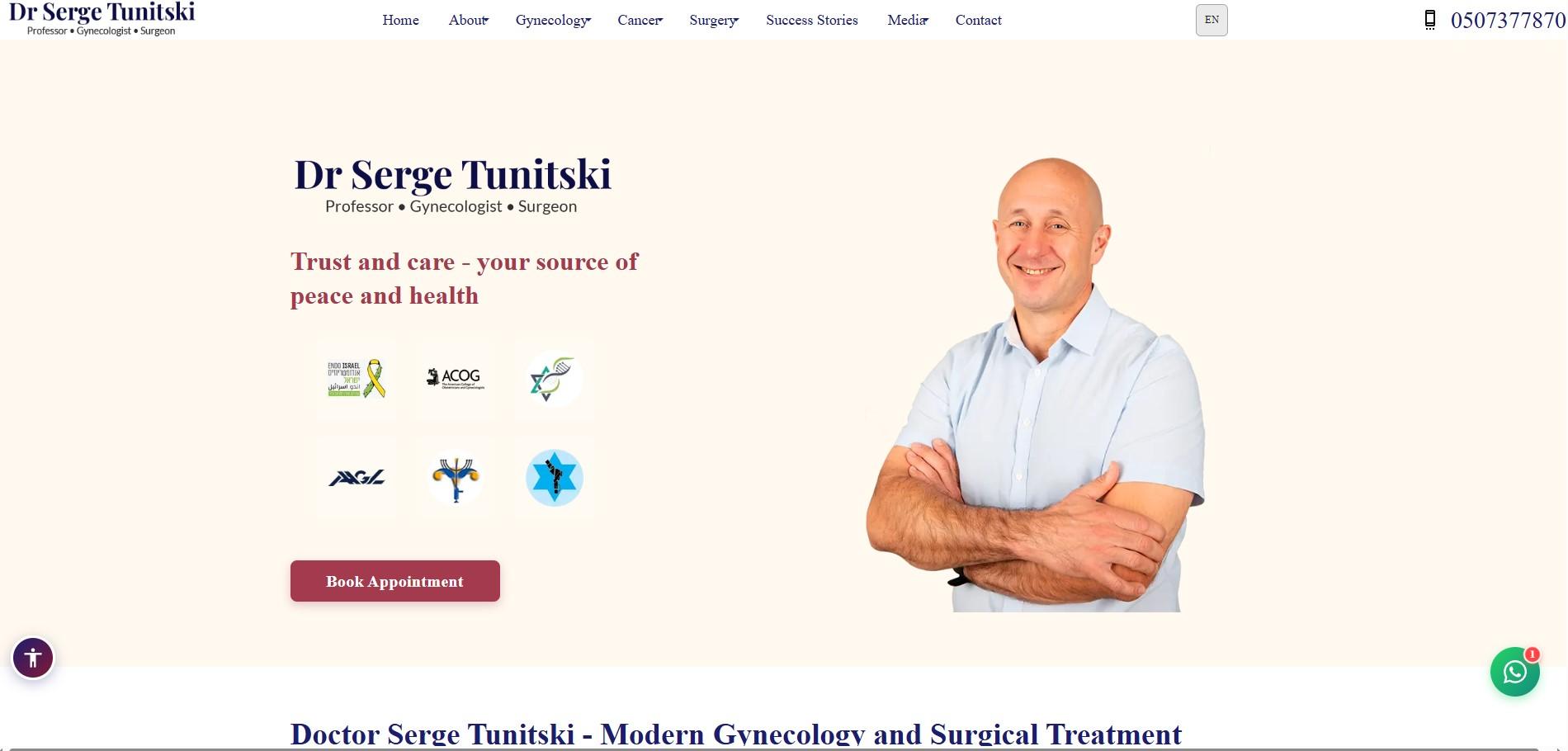
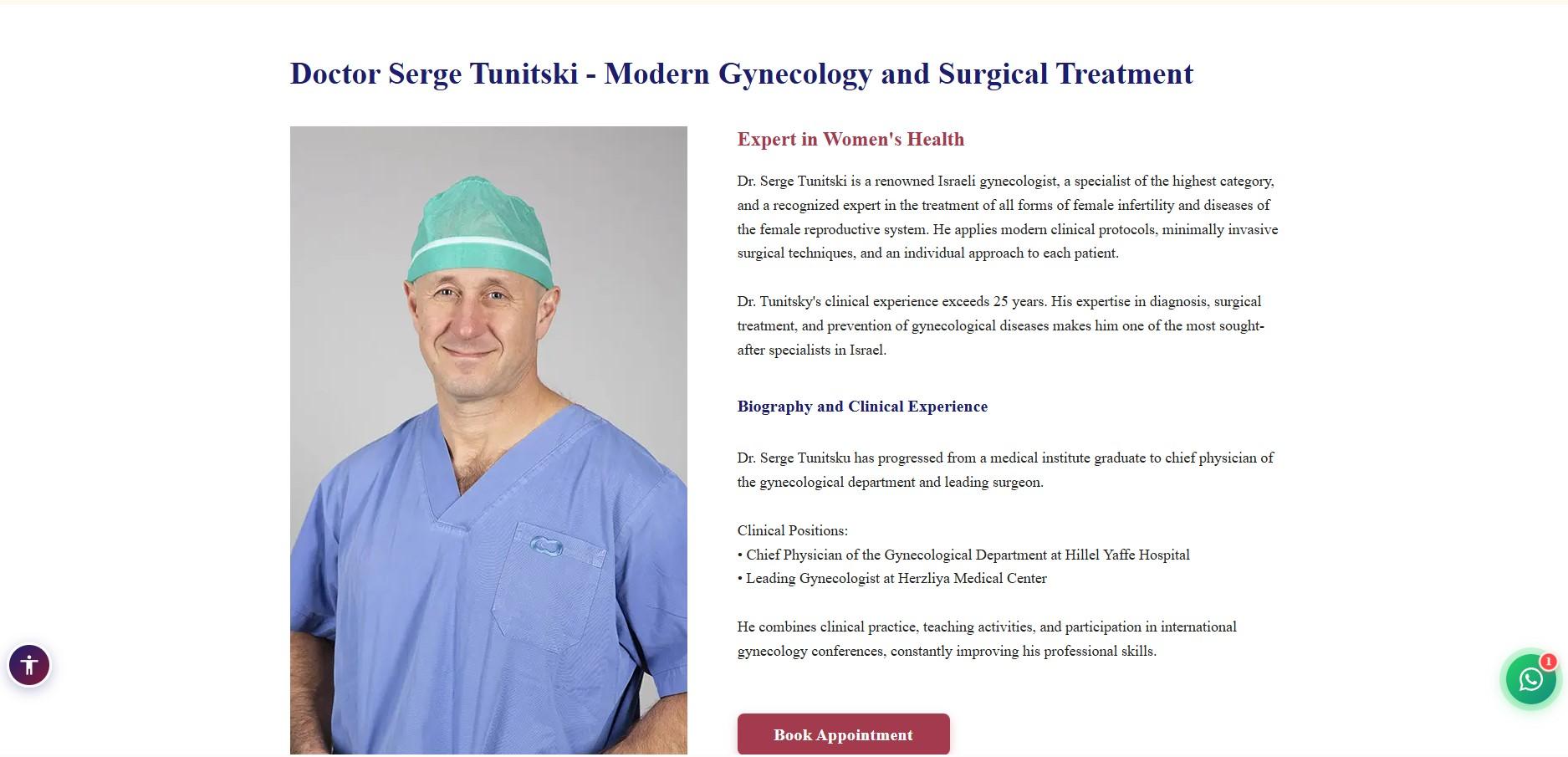
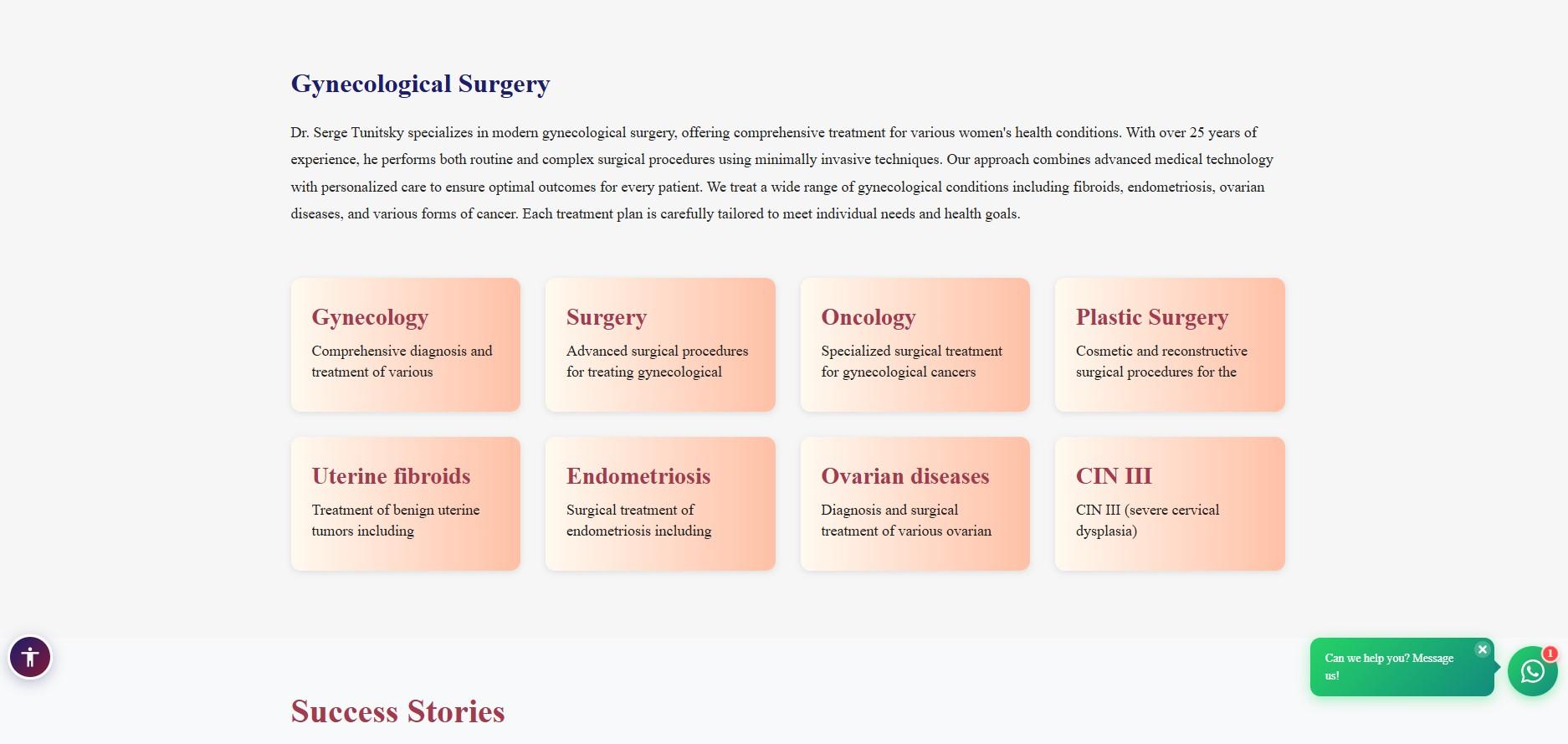
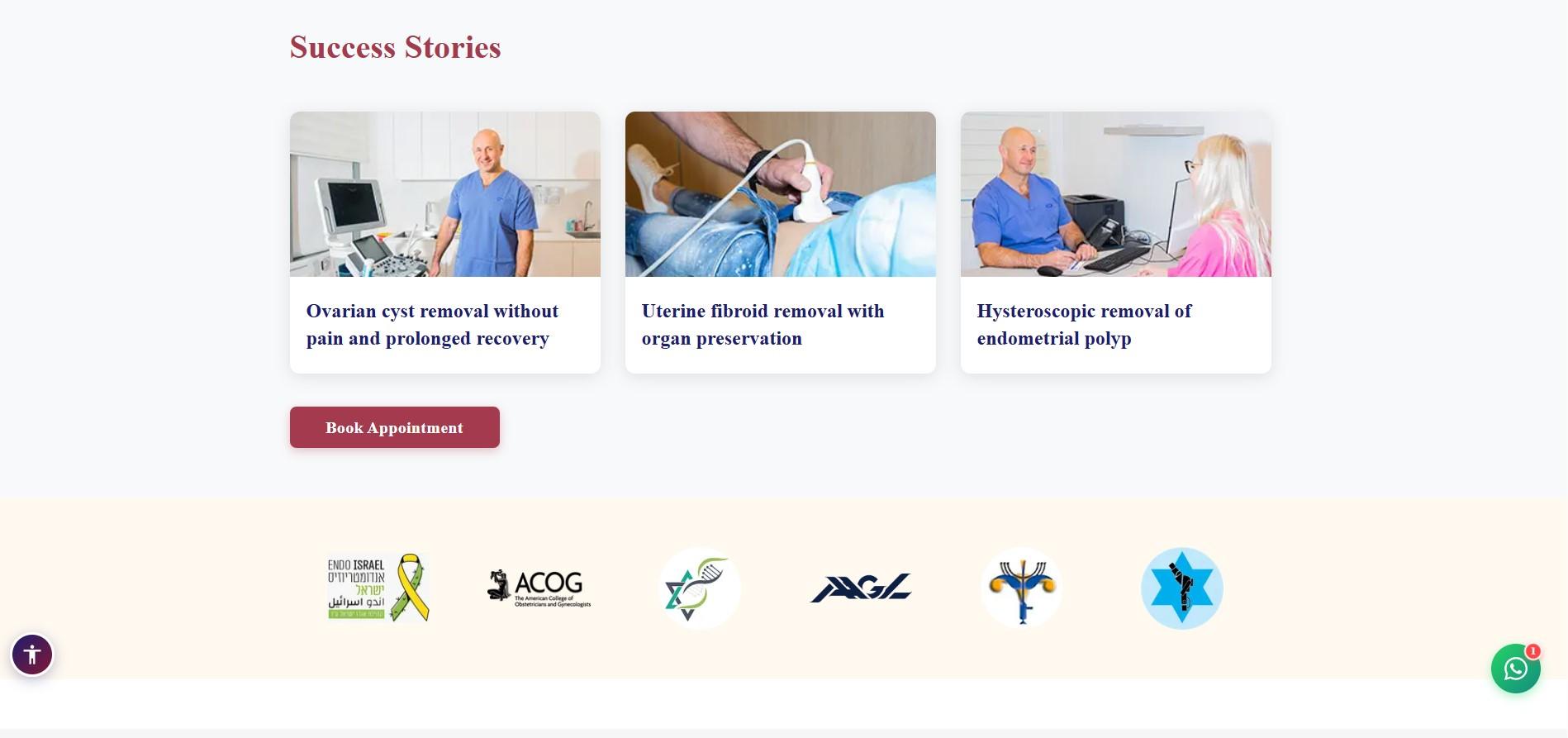
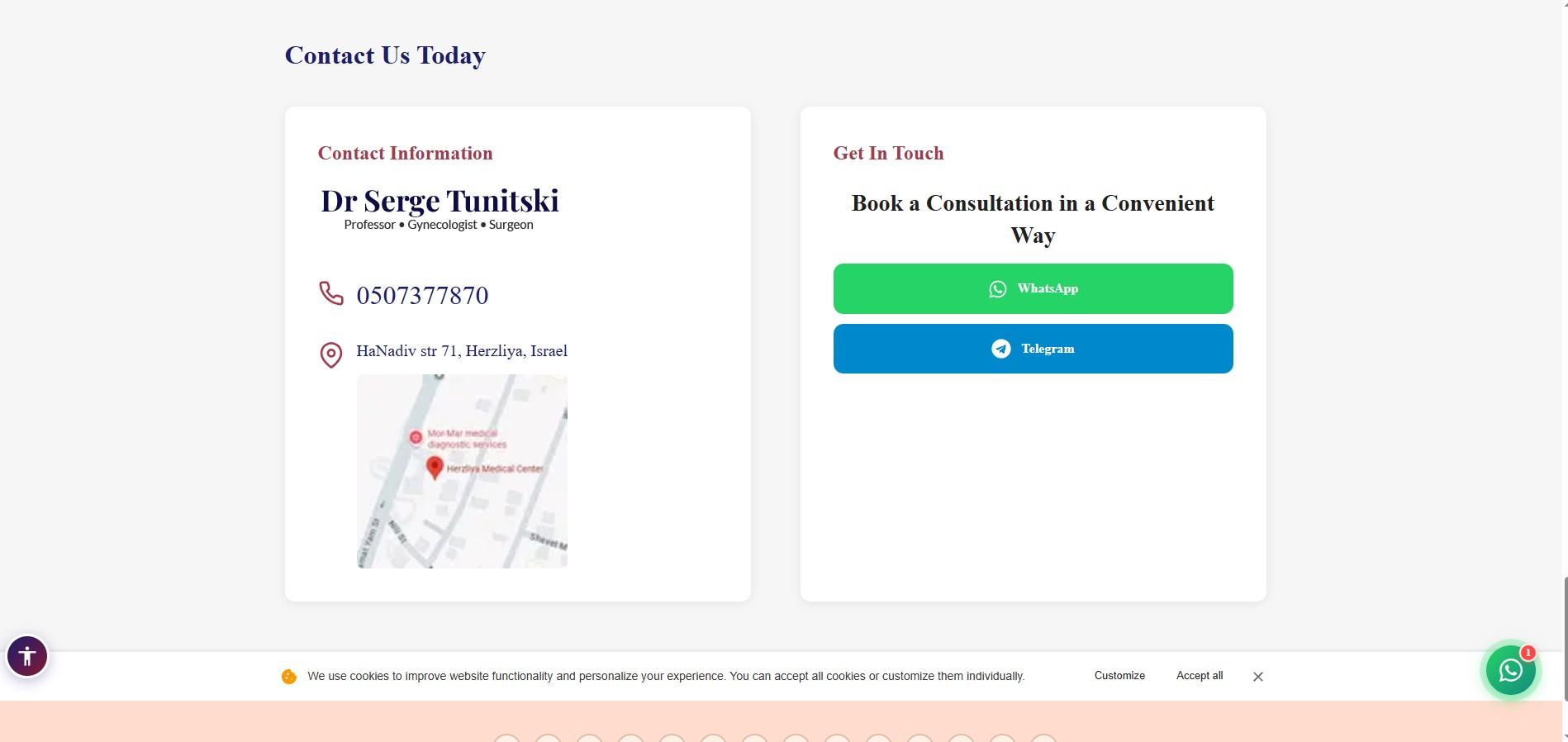
Gallery of the Dr. Serge Tunitski Clinic
Core Project Tasks and Client Expectations
Before implementation, a comprehensive set of objectives was defined, covering both medical specificity and long-term digital strategy:
-
Conduct an in-depth analysis of the medical domain, taking into account regulatory constraints, content sensitivity, and search engine requirements for medical websites.
-
Develop an SEO-oriented website architecture based on semantic research and clinical logic, rather than conventional marketing blocks.
-
Create a design concept that conveys professionalism, clinical rigor, and trust, without excessive visual pressure or aggressive promotional triggers.
-
Implement a modern, high-performance frontend using React and Next.js, with a strong focus on loading speed, adaptability, and technical SEO.
-
Use WordPress as a scalable and manageable backend for medical content publication and expert materials.
-
Prepare and adapt content in three languages while maintaining medical accuracy, terminological precision, and semantic consistency.
The Client’s expectation was to create a digital equivalent of a clinical consultation — a website that does not reduce medicine to marketing slogans, but instead explains, structures, and accompanies the patient during the process of informed decision-making.
2. Preliminary Analysis
2.1 Niche and Medical Domain Analysis
Developing a digital product for the medical sector differs fundamentally from work in general commercial niches. Gynecology and surgical medicine fall under the YMYL (Your Money or Your Life) category, where any information may directly or indirectly affect a patient’s health, quality of life, and clinical decisions.
For this reason, the preliminary niche analysis was built not only around marketing and SEO metrics, but also around the intrinsic requirements of medical content itself.
A critical factor in this domain is strict adherence to E-E-A-T principles (Experience, Expertise, Authoritativeness, Trustworthiness). Search engines — particularly Google — apply enhanced scrutiny to medical sources, prioritizing websites where:
-
The physician’s identity, clinical background, and professional qualifications are clearly presented.
-
Content is grounded in evidence-based medicine rather than generalized or promotional claims.
-
Site structure and textual tone convey medical responsibility rather than commercial pressure.
-
Real contact information, geographic presence, and operational transparency are clearly visible.
Within the medical content analysis, special attention was paid to semantic accuracy, the permissible level of simplification for patient comprehension, and the balance between scientific rigor and accessibility. In gynecology, content cannot be excessively academic nor overly simplified — it must serve as a tool for primary medical orientation without replacing an in-person consultation.
From a practical standpoint, three elements are critical for a medical website:
-
Clearly structured descriptions of services and treatment areas.
-
Evidence-based, logically organized information on diagnostic methods and surgical procedures.
-
Instantly visible and accessible communication channels connecting patients with the clinic and physician.
This triad forms patient trust prior to the first interaction and serves as the foundation for both behavioral metrics and appointment conversion.
2.2 SEO Analysis
The SEO analysis was conducted at both the local level (Israel’s medical services market) and within a broader international context, including an examination of best practices among leading gynecological and surgical clinics in Europe, the United States, and other regions with advanced healthcare infrastructures.
Competitor Analysis in Gynecology and Surgical Medicine
At the initial stage, a comparative analysis was performed across direct and indirect competitors:
-
Private gynecology clinics
-
Personal websites of gynecologist-surgeons
-
Multidisciplinary medical centers with surgical profiles
The analysis covered:
-
Website structure and depth of page hierarchy
-
Distribution of medical specialties and services
-
Presentation of the physician as the central expert authority
-
Content formats: informational articles, procedure descriptions, FAQs, press sections
-
SEO parameters: heading hierarchy, metadata, keyword density, and distribution
Additionally, best-in-class international websites within the English-speaking medical segment were analyzed, where medical SEO practices demonstrate a higher level of maturity. This revealed consistent patterns: a strong focus on symptom-oriented pages, clear separation of diagnostics and treatment content, and active use of expert-driven materials as a trust-building mechanism.
Semantic Analysis and Query Clustering Strategy
Semantic research was built around the medical logic of patient behavior rather than abstract commercial intent. Query clustering followed a natural progression — from symptoms and diagnoses to treatment methods and specialist selection. Queries were grouped into meaningful clusters reflecting real patient needs:
-
General gynecology
-
Surgical gynecology
-
Specific surgical procedures and interventions
-
Consultations and second opinions
-
Informational queries related to diagnoses and clinical conditions
Each cluster was mapped to a dedicated landing page, eliminating keyword cannibalization and ensuring precise alignment with search intent.
Semantic Core Development
Based on the analysis, an extended semantic core was сформed, including:
-
High- and mid-frequency medical queries
-
Low-frequency but high-conversion search phrases
-
Geo-dependent queries
-
Informational queries for expert articles and the press center
The semantic core became the foundation for:
-
Website architecture
-
The structure of the “Gynecology” and “Surgical Procedures” sections
-
Multilingual content development
-
Long-term SEO strategy across the entire project
3. Website Architecture and Medical Navigation Logic
Designing the website architecture for Dr. Serge Tunitski’s clinic became one of the most critical stages of the project, as medical websites require far more than a simple hierarchical page structure. They demand a clinically grounded navigation model that reflects the real patient journey — from symptoms and diagnosis to a specific medical service and consultation booking.
The site architecture was built using a semantic–clinical modeling approach, where each page simultaneously performs three key functions:
-
medical and educational;
-
SEO landing page;
-
conversion-oriented (preparing the patient for direct contact with the physician).
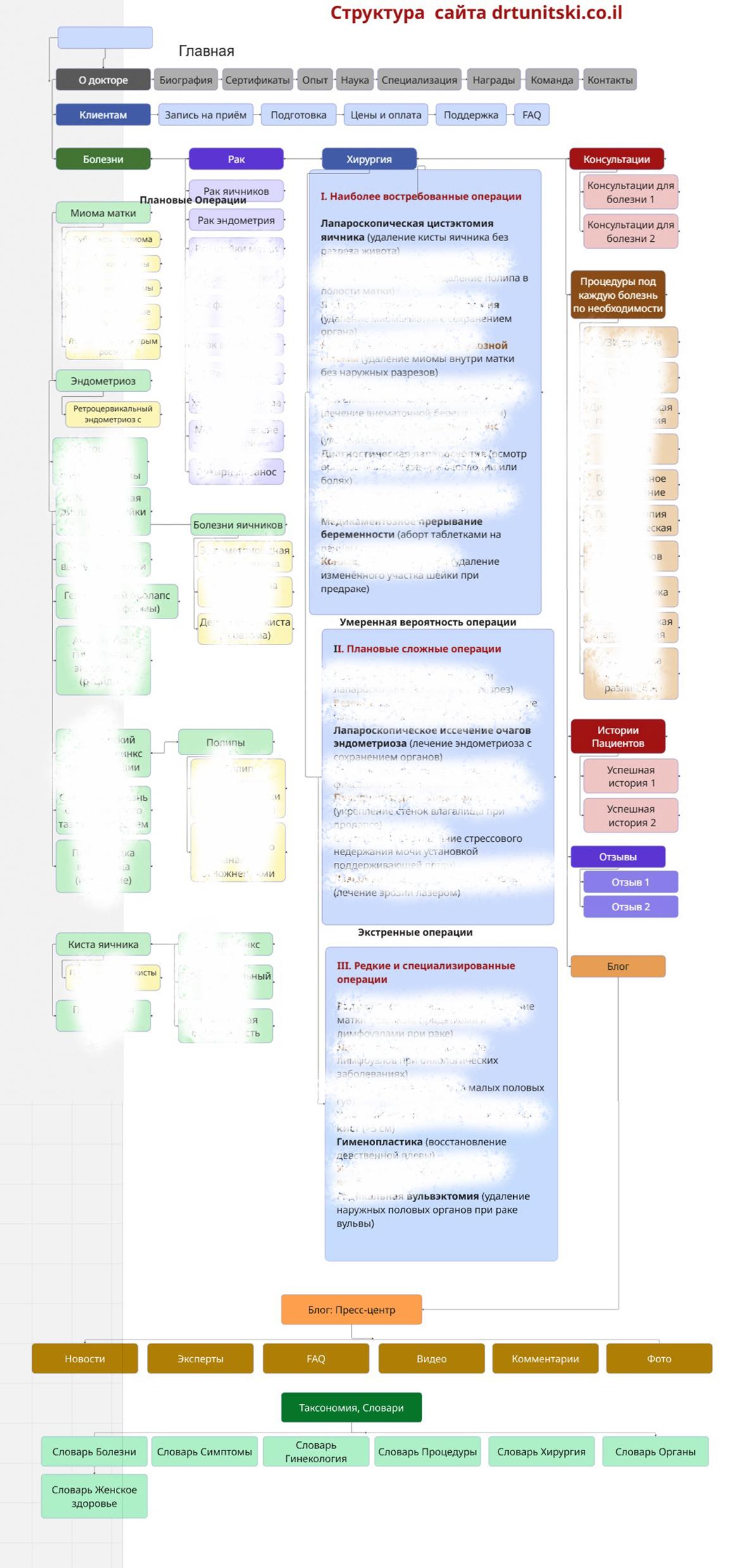
Dr. Serge Tunitski Clinic Website Structure
Home Page
The Home page serves as the primary point of initial medical trust. It is deliberately free from aggressive marketing messages and intrusive calls to action. Instead, it structures the perception of the clinic through:
-
the physician’s specialization;
-
key treatment areas;
-
professional experience and expertise;
-
instantly accessible communication channels.
From an SEO perspective, the Home page consolidates high-frequency branded and general medical queries while acting as a central hub for internal linking across the website.
About Section — Building Expert Trust
The “About” section was intentionally expanded and decomposed into multiple subpages. In the medical domain, the physician’s identity and clinical infrastructure are core E-E-A-T factors.
Dr. Serge Tunitski
The doctor’s page is not a traditional biography, but a structured expert profile. Clinical experience, specialization, and professional trajectory are presented through the lens of medical competence rather than self-promotion.
Clinic & Our Team
This section strengthens trust by demonstrating the clinical environment in which treatment is delivered — including the medical team, clinical facilities, and organizational structure.
Medical Tourism
A dedicated landing page designed for international traffic and queries related to treatment in Israel. The page is optimized for geo-dependent and transactional search intent.
Types of Consultation / Request Appointment / Preparation / Prices
These pages form a pre-consultation framework that reduces patient anxiety and lowers the barrier to booking an appointment. They guide users logically toward action without violating medical ethics or applying commercial pressure.
Gynecology Section — Symptom-to-Diagnosis Model
The “Gynecology” section is structured according to a clinical classification of surgical interventions, rather than a marketing-based hierarchy — a fundamental and intentional distinction.
Subdivision into:
-
Planned surgeries
-
Moderate-risk surgeries
-
Emergency surgeries
reflects real clinical decision-making processes while simultaneously enabling precise SEO query clustering.
Each nosology (uterine fibroids, endometriosis, ovarian cysts, pelvic organ prolapse, etc.) is represented by a dedicated landing page optimized for:
-
symptom-based queries;
-
diagnostic terminology;
-
treatment- and surgery-related searches.
As a result, patients can enter the site either via a confirmed diagnosis or through a description of clinical symptoms.
Cancer Section — Oncogynecology as a Dedicated Expert Domain
The oncology section is separated into an independent logical entity, emphasizing its elevated clinical, ethical, and informational significance.
Each oncological condition (endometrial cancer, cervical cancer, uterine sarcoma, metastatic tumors, etc.) is presented on an individual page, enabling:
-
avoidance of semantic overlap between diagnoses;
-
precise alignment with search intent;
-
establishment of medical authority within a highly sensitive YMYL niche.
Surgery Section — Operative Expertise
The “Surgery” section is structured according to the complexity and specialization level of interventions:
-
Important surgeries
-
Complex surgeries
-
Specialized surgeries
-
Plastic surgery
This hierarchy reflects surgical depth and professional competence rather than service marketing. It is especially valuable for patients seeking second opinions or advanced surgical treatment.
Each procedure has its own unique URL, creating a powerful network of SEO landing pages targeting low- and mid-frequency but highly conversion-oriented queries.
Media and Press Center — Expert Content and Trust Building
The Media section consolidates:
-
clinic blog;
-
expert medical articles;
-
news;
-
FAQ;
-
video testimonials and success stories.
This forms the informational core of the website, improving behavioral metrics, session depth, and compliance with search engine requirements for medical resources.
User Journey Logic (UX)
Site navigation follows a clinically logical model:
Symptom → Diagnosis → Treatment Method → Surgery → Consultation Booking
At every stage, the user receives:
-
relevant and structured medical information;
-
unobtrusive but constantly available communication options;
-
instant access to WhatsApp, Telegram, or Email.
SEO Considerations and Page Structure (UI/UX)
Each page was designed as:
-
an independent SEO unit;
-
a component of a logical conversion funnel;
-
part of a unified medical information architecture.
Page structure includes:
-
correct H1–H3 hierarchy;
-
medically accurate subheadings;
-
modular UI composition;
-
UX patterns that reduce cognitive load.
4. Design Based on User Experience Analysis (UI/UX)
The visual and interface concept of Dr. Serge Tunitski’s clinic website was developed not around design trends, but around behavioral and cognitive UX analysis within a medical context. Unlike e-commerce or service platforms, a medical interface performs a critical function — reducing patient anxiety and establishing primary trust before any personal interaction.
Design was therefore treated as a tool of clinical communication rather than decoration.
UI/UX Principles: Trust, Cognitive Clarity, Medical Neutrality
The core UI/UX principle was cognitive simplicity with high informational density. Medical users typically arrive in a state of uncertainty or stress; therefore, the interface must not amplify cognitive load.
Key UX axioms included:
-
intuitive visual hierarchy without the need for learning;
-
structured medical content with minimal visual noise;
-
navigation that avoids unnecessary decision-making;
-
immediate visibility of trust elements (physician name, specialization, experience, contacts).
UI decisions strictly followed medical ethics: no aggressive CTAs, minimal marketing triggers, and avoidance of visual metaphors that could be perceived as manipulative.
Figma Prototypes: Screen Architecture and Responsive Logic
Interface design was carried out in Figma with prior modeling of user scenarios for different audience types: local patients, international patients, repeat visitors, and informational users.
The prototypes included:
-
detailed layouts for key screens;
-
dedicated scenarios for specialty, surgery, and expert content pages;
-
adaptive grids for desktop, tablet, and mobile;
-
unified UI components across all sections.
Mobile UX received special focus, as a significant share of medical searches occurs on smartphones. The mobile version was designed as an independent scenario optimized for fast information access and immediate contact.
Adaptive behavior was implemented not only at the layout level but also at the semantic level — prioritizing critical medical information and contact channels on mobile.
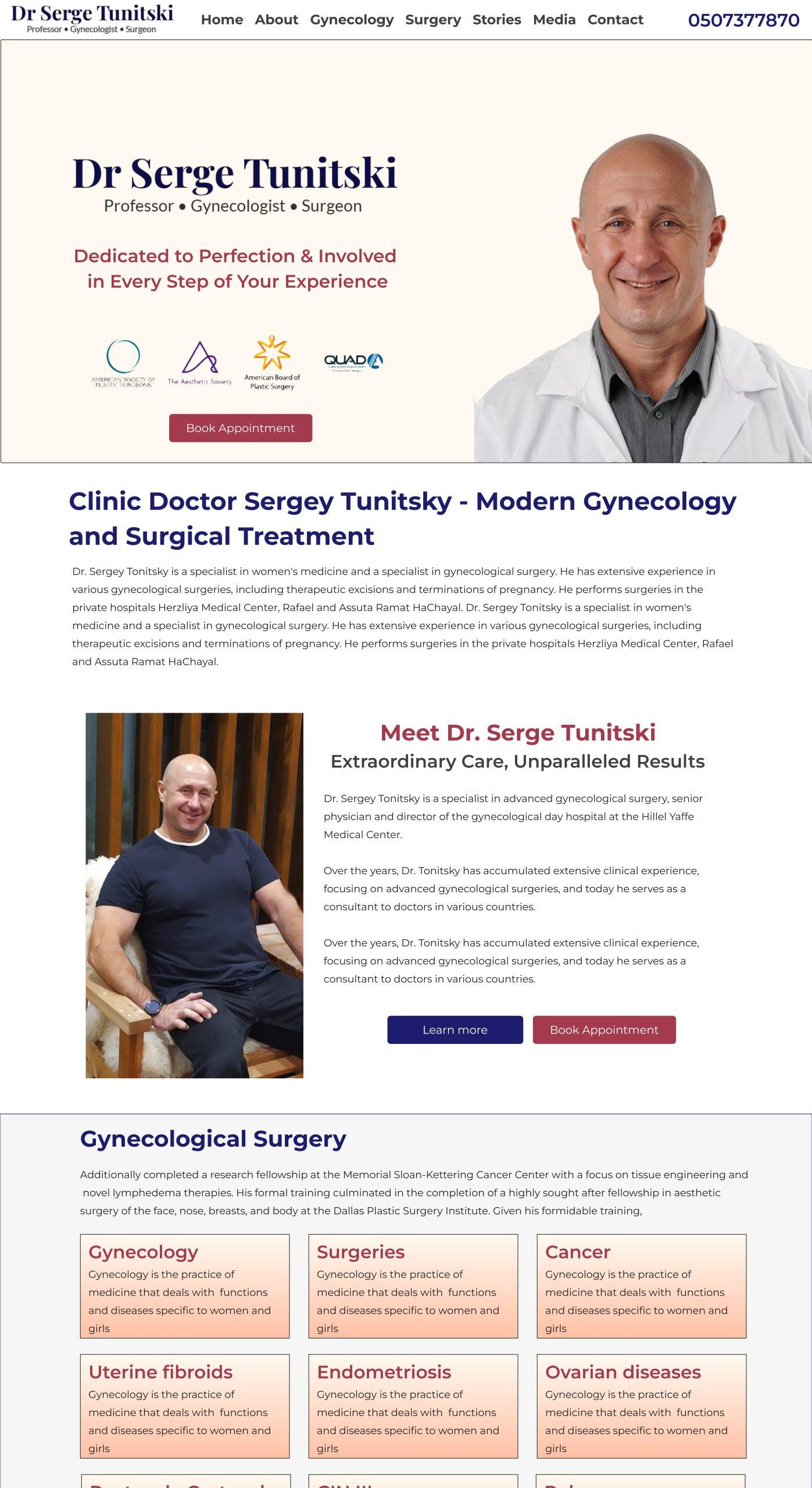
Figma layout of the main page of Dr. Tunitski’s Clinic website
Visual Style: Clinical Precision and Trust Without Visual Pressure
The visual style was defined by the requirements of the medical YMYL segment. Excessive creativity, complex effects, and emotionally charged visuals were intentionally excluded.
Core visual principles:
-
neutral, clinically associated color palette;
-
absence of visual aggression and sharp contrast;
-
clear typographic hierarchy;
-
generous spacing and rhythmic layout.
This approach allows users to focus on content rather than form and creates a perception of professional medical environment consistent with offline clinical experience.
From an SEO and behavioral standpoint, this design contributes to:
-
longer session duration;
-
reduced bounce rates;
-
increased trust in content and physician authority.
5. Frontend Implementation and High-Performance Client Architecture
The frontend of Dr. Serge Tunitski’s clinic website was implemented as a standalone, high-performance client interface optimized for speed, stability, and accurate indexing of medical content by search engines. Technology choices were driven by the need to align medical credibility, YMYL SEO requirements, and modern web performance standards.
Technology Stack: React + Next.js
React combined with Next.js was selected as the core technology, enabling a hybrid architecture that merges SPA interactivity with server-side rendering benefits.
Next.js provided:
-
predictable routing;
-
code splitting;
-
optimized image handling;
-
native support for SEO-critical scenarios.
This is particularly important for medical websites, where proper indexing of text, headings, and structured data directly affects search trust and organic visibility.
Performance Architecture: SSR, SSG, and Speed Optimization
A hybrid rendering model was implemented:
-
SSR (Server-Side Rendering) for SEO-critical and dynamic pages, ensuring immediate HTML delivery to search engines.
-
SSG (Static Site Generation) for stable informational sections, reducing response time and server load.
Core Web Vitals optimization included:
-
minimizing First Contentful Paint (FCP);
-
improving Largest Contentful Paint (LCP);
-
controlling Cumulative Layout Shift (CLS).
Additional optimizations:
-
lazy loading of components;
-
prioritized loading of critical resources;
-
media compression and optimization;
-
elimination of unnecessary third-party libraries.
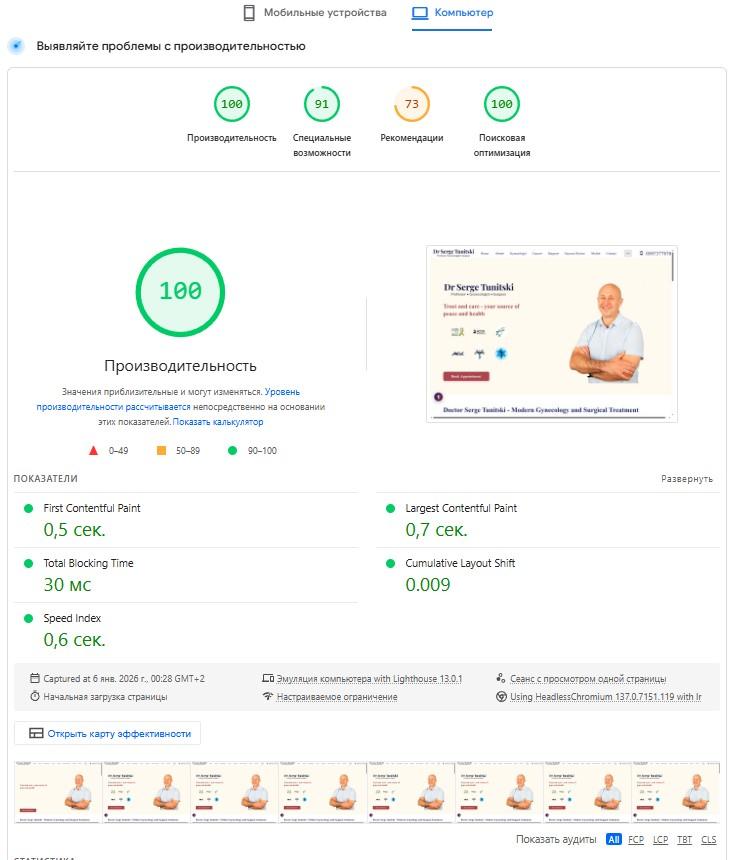
PageSpeed Insights (Mobile): First Contentful Paint ≈ 0.9s
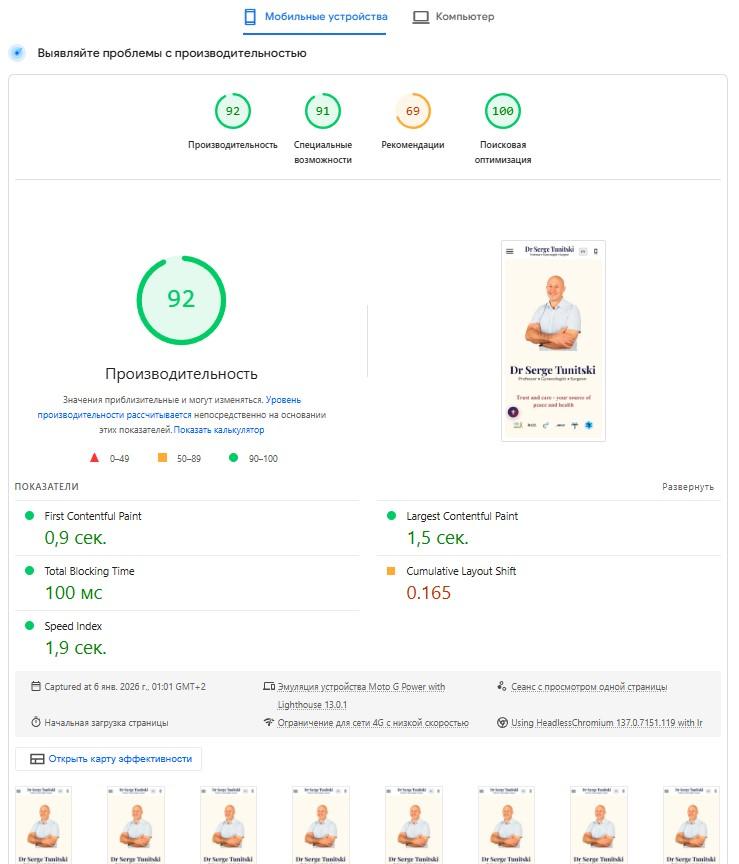
PageSpeed Insights (Desktop): First Contentful Paint ≈ 0.5s
Interactive Elements and User Interaction
Interactive components were implemented with strict UX constraints appropriate for medical contexts.
Key interaction elements include:
-
adaptive multi-level navigation menu;
-
interactive consultation booking buttons;
-
contextual CTAs embedded naturally within medical content;
-
dynamic content loading without page reloads.
Booking buttons are integrated with WhatsApp, Telegram, and Email and remain accessible throughout the user journey without creating visual pressure.
Responsiveness and Cross-Platform Compatibility
The frontend is fully responsive across devices and screen sizes. Responsiveness is implemented at both CSS and component logic levels.
Menus, forms, and navigation adapt automatically to ensure:
-
equal usability on desktop and mobile;
-
no functional limitations;
-
stable performance even on low-bandwidth connections.
Deployment and Delivery Infrastructure: Vercel
Frontend deployment was implemented via Vercel, enabling:
-
global CDN content delivery;
-
automatic builds on code updates;
-
instant scalability without manual administration;
-
reliable SSR and SSG at the edge level.
This is critical for a medical website with international traffic, reducing latency worldwide and positively impacting SEO metrics.
Custom Design System as an SEO Stability Factor
A proprietary SCSS-based design system was implemented, including:
-
centralized color palette configuration;
-
typography and heading mixins;
-
unified component styling.
This ensures:
-
visual consistency;
-
predictable DOM structure;
-
rendering stability;
-
reduced SEO degradation risk during scaling.
Accessibility, Security, and Regulatory Compliance (Frontend Layer)
Beyond core functionality, the frontend includes extended infrastructure for accessibility, legal compliance, and data protection — essential for medical digital products.
Accessibility Interface
An accessibility button provides a modal interface with tools for:
-
text size adjustment;
-
contrast enhancement;
-
visual simplification;
-
UI control adaptation.
The solution is natively integrated, SEO-safe, and compatible with assistive technologies, aligning with inclusive design principles.
Google reCAPTCHA
Google reCAPTCHA protects appointment forms and contact channels from automated abuse while preserving usability and conversion rates.
Legal and Informational Footer
The footer includes:
-
an accessibility information page;
-
Privacy Policy;
-
data processing compliance elements.
All pages are structured as independent SEO entities.
Cookie Consent
A compliant cookie consent modal is implemented with:
-
first-visit display;
-
preference persistence;
-
no content blocking;
-
compatibility with analytics scripts.
Multilingual Interface Synchronization
All interface elements — accessibility tools, modals, forms, legal pages, and cookie banners — automatically display in the user-selected language, ensuring UX integrity and legal clarity.
Infrastructure Layer: Cloudflare
Cloudflare was integrated as an additional security and acceleration layer, providing:
-
DDoS and bot protection;
-
global CDN delivery of static assets;
-
improved stability during peak loads;
-
faster response times for international users.
From an SEO standpoint, Cloudflare positively affects Core Web Vitals and content availability — a critical trust factor for medical websites.
6. Backend Development and Content Infrastructure
The backend layer of the project was designed as a stable, scalable, and semantically controlled system capable of supporting a complex medical website architecture. Given the YMYL nature of the domain and the multilingual structure of the project, it was critically important to clearly separate responsibilities between the visual layer (frontend) and the data management layer (backend), while preserving the integrity of SEO logic and medical terminology.
WordPress as the CMS Core of a Medical Project
WordPress was selected as the content management system, not in its traditional monolithic form, but as a dedicated content and administrative layer focused on managing medical data, expert texts, and structured clinical information.
The choice of WordPress was driven by several key factors:
-
flexible page and hierarchical content management model;
-
precise editorial control over medical texts and terminology;
-
extensibility through custom post types and custom fields;
-
usability for physicians and clinic administrators when updating content.
The CMS was adapted to support a complex structure comprising dozens of medical specialties, surgical procedures, and expert materials without compromising manageability or semantic clarity.
Headless Architecture: WordPress and Next.js Integration via API
The backend–frontend integration was implemented using a Headless WordPress approach, where WordPress acts as a data provider and Next.js serves as the content consumer and presentation layer.
Data exchange is handled through an API layer (REST / GraphQL-like logic), enabling:
-
complete separation of content from presentation;
-
high page load speed and performance stability;
-
elimination of limitations imposed by traditional WordPress themes;
-
implementation of hybrid SSR/SSG rendering on the frontend.
This approach is especially critical for medical websites, where the following are required:
-
strict control over clinical language and terminology;
-
predictable and SEO-safe URL structures;
-
absence of conflicts between SEO requirements and UI implementation.
Medical Content Structure and Section Management
A structured model of medical entities was developed for the project, where each content type has a clearly defined purpose and semantic role.
The CMS includes:
-
dedicated post types for gynecology, surgery, and oncology directions;
-
individual content templates for procedures and clinical cases;
-
logical page hierarchies aligned with medical classification standards;
-
centralized navigation and internal linking management.
This architecture allows the website to:
-
scale without breaking structural integrity;
-
maintain high page uniqueness;
-
avoid duplication of medical content.
SEO Fields and Search Optimization Control
An advanced system of SEO fields was implemented for every page and content type, providing full control over the site’s search representation.
Managed parameters include:
-
individual title and meta description;
-
canonical URLs;
-
SEO headings;
-
logical H-tag hierarchy;
-
metadata for multilingual versions.
This enables the creation of landing pages for specific search intent clusters and ensures precise alignment with user intent — a critical factor in competitive medical niches.
Multilingual Architecture and Medical Terminology Consistency
The multilingual architecture is implemented at the backend level, ensuring:
-
a single source of truth for all language versions;
-
structural consistency across languages;
-
preservation of semantic logic between translations.
Each language version is managed as part of a unified content system rather than as a separate website. This approach allows:
-
avoidance of discrepancies in medical terminology;
-
correct implementation of hreflang attributes;
-
accurate indexing across different linguistic regions.
WordPress Modules Used for Custom and Headless Development
The project employs a professional WordPress development ecosystem that treats the CMS as a flexible backend rather than a template-based website builder.
Advanced Custom Fields (ACF)
The core module for:
-
creating custom fields;
-
defining page structures;
-
storing SEO data;
-
managing complex medical sections.
Used for:
-
text blocks;
-
service lists;
-
medical parameters;
-
repeatable sections (Repeater);
-
flexible layouts (Flexible Content).
Custom Post Types (CPT UI or Code-Based)
Used to:
-
create distinct content types (services, surgeries, articles, cases, FAQ);
-
logically separate medical data;
-
maintain clean, SEO-friendly URL structures.
Some post types are registered via UI, others directly in code.
Polylang (Multilingual Management)
Applied for:
-
content translation management;
-
linking language versions;
-
SEO-compliant multilingual structure;
-
hreflang integration with the frontend.
Yoast SEO (SEO Layer)
Used as:
-
an interface for managing SEO metadata;
-
a data source for the headless frontend;
-
a sitemap.xml generator;
-
a robots meta management tool.
Even with custom SEO logic, Yoast remains a convenient editorial interface.
WPGraphQL
Used for:
-
transferring data from WordPress to Next.js;
-
headless architecture implementation;
-
dynamic page generation;
-
multilingual API queries.
WPGraphQL is primarily used for complex data structures, while REST handles simpler tasks.
Code Snippets
Used for:
-
adding custom logic without modifying core files;
-
registering taxonomies;
-
filtering API responses;
-
SEO rules and environment-based conditions.
Cache Plugins (Limited Use)
Applied for:
-
admin panel optimization;
-
API response caching;
-
without conflicts with Next.js SSR/SSG logic.
Security Modules (Wordfence)
Used for:
-
admin panel protection;
-
login attempt limitation;
-
API endpoint security;
-
compliance with medical project security requirements.
Optimizers (Optional)
Used for:
-
image optimization;
-
media management;
-
reducing server load.
WordPress Stack Summary
WordPress was used with a classic professional development stack, including:
-
custom fields;
-
custom post types;
-
multilingual support;
-
SEO layer;
-
API integration;
-
security modules.
This positions the CMS not as a template engine, but as a controlled and scalable backend for a complex medical platform.
Reliability, Scalability, and Long-Term Control
The backend architecture was designed with future growth in mind, including:
-
adding new treatment directions;
-
expanding content sections;
-
introducing additional languages;
-
integrating external medical services.
In this implementation, WordPress functions not as a conventional CMS, but as a controlled medical content hub, ensuring long-term stability, manageability, and SEO efficiency.
7. Content Strategy and Medical Copy Development
Within the project, content was treated not as a secondary design element but as the core semantic and expert infrastructure of the website. It directly impacts patient trust, compliance with search engine requirements, and the effectiveness of organic promotion in a medical YMYL niche.
Content development followed the principles of evidence-based medicine, semantic relevance, and cognitive accessibility, with strict adherence to E-E-A-T factors (Experience, Expertise, Authoritativeness, Trustworthiness).
“About / Physician” Section Content
The “About / Physician” section serves as the primary trust-building component, which is especially critical for medical websites in surgery and oncogynecology.
Content was structured around the following axes:
-
clinical experience as a continuous professional process;
-
specialization in complex and non-standard cases;
-
medical responsibility and personalized patient approach;
-
compliance with international clinical standards.
Unlike marketing-style biographies, these texts are oriented toward rational medical perception, avoid promotional language, and emphasize the physician’s professional identity as a practicing specialist.
From an SEO perspective, this section targets:
-
branded queries;
-
specialist-related searches;
-
trust- and expertise-oriented search formulations.
Gynecology Section: Symptom–Diagnostic Content
The gynecology section follows a medical problem decomposition model, where each nosological unit is presented as an independent informational and clinical module.
Content is structured to:
-
address symptom-based and diagnostic queries;
-
explain the clinical logic behind treatment choices;
-
build informed understanding of indications for surgery or observation.
Each page includes:
-
clinical condition overview;
-
diagnostic methods;
-
indications for surgical intervention;
-
explanation of risks and outcomes.
SEO optimization focuses on:
-
mid- and low-frequency medical queries;
-
long-tail search phrases;
-
high topical relevance without artificial keyword stuffing.
Surgery Section: Expert Procedural Framework
The surgery section was developed as a procedure-oriented representation of surgical practice, where each operation is presented as a medical solution within a specific clinical context rather than as a commercial service.
Content includes:
-
indications for surgery;
-
procedural methodology;
-
possible alternatives;
-
postoperative aspects and recovery.
Special attention was given to terminological accuracy and avoidance of oversimplification that could distort clinical meaning.
From an SEO perspective, this section creates:
-
high-conversion landing pages;
-
clear diagnosis-to-treatment relationships;
-
strong expert signals for search engines in a competitive medical niche.
Press Center: Expert Content and Medical Authorship
The Press Center serves a strategic role in reinforcing medical authority and demonstrating the physician’s active expert position.
Content includes:
-
analytical articles;
-
expert commentary;
-
clinical case analyses;
-
answers to frequently asked patient questions.
The section targets:
-
informational search queries;
-
semantic expansion;
-
long-term trust building.
For search engines, it strengthens:
-
topical authority;
-
behavioral metrics;
-
depth of user engagement.
The Role of Content in the Project
The result is a multi-layered content ecosystem in which each text:
-
is logically integrated into the site architecture;
-
functions as an independent SEO unit;
-
reinforces medical expertise;
-
guides users through every decision-making stage.
Content became the semantic backbone of the project, uniting medical expertise, digital architecture, and user experience into a single, trustworthy, and highly effective system.
8. Comprehensive Technical SEO and Health Score Improvement (Ahrefs)
A full technical SEO framework was implemented with a focus on the medical YMYL niche, where infrastructure quality, accessibility, and security are as critical as content and semantics.
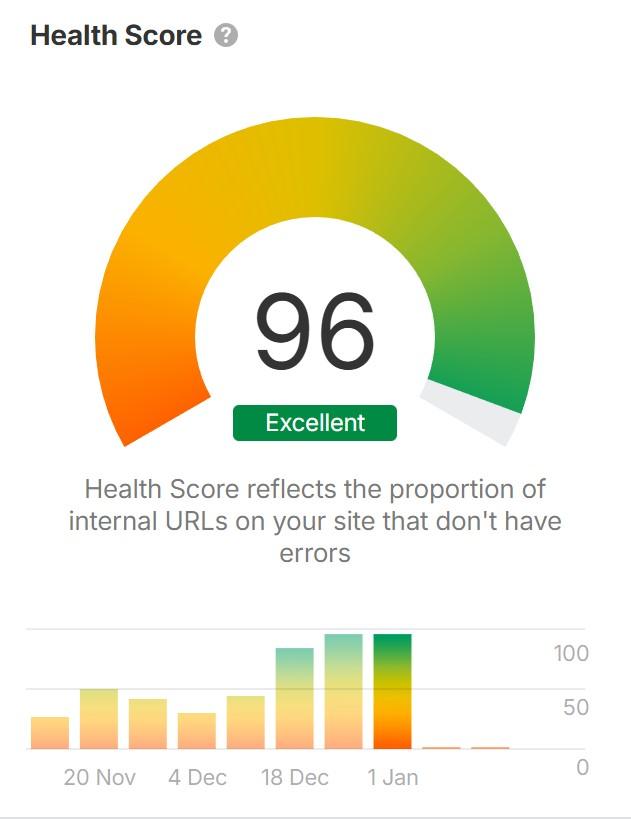
All SEO configurations were implemented at the frontend architecture and headless backend levels, enabling precise control over indexation, multilingual markup, and a significant improvement in Ahrefs Health Score.
Health Score reflects the proportion of internal URLs on your site that don’t have errors
Indexation and Environment-Based SEO Control
To prevent premature indexation of test and intermediate versions, a dynamic environment-based meta robots system was implemented:
-
automatic noindex, nofollow for development and staging environments;
-
index, follow exclusively in production;
-
centralized logic eliminates human error during deployment.
Additionally:
-
robots.txt is properly configured;
-
system and service URLs are blocked;
-
consistency between robots.txt and meta robots is maintained.
Core Technical SEO Framework
A complete set of mandatory and advanced SEO meta elements was implemented:
-
dynamic titles based on page structure and branding;
-
unique meta descriptions for every landing page;
-
correct canonical URLs generated as BASE_URL + router.asPath;
-
extended robots meta tags;
-
adaptive viewport with controlled max-scale for mobile;
-
strict UTF-8 encoding;
-
author meta to reinforce expert signals.
This approach ensures:
-
elimination of duplicate pages;
-
proper link equity distribution;
-
stable indexation of complex Next.js routes.
Multilingual and International SEO
The site supports 7 languages:
en, ru, he, de, fr, es, ar
Primary languages were intentionally selected as:
-
English;
-
Hebrew;
-
Russian;
to match target markets and clinical practice.
Implemented features include:
-
hreflang tags for all language versions;
-
x-default fallback;
-
og:locale per language;
-
og:locale:alternate for alternatives;
-
full RTL support (Hebrew, Arabic).
This ensures:
-
correct geo- and language relevance;
-
absence of conflicts between language versions;
-
improved international SEO quality.
Open Graph and Social Semantics
A complete Open Graph implementation ensures correct display across social platforms and messengers:
-
og:title, og:description, og:url (dynamic);
-
og:type (website / article);
-
og:site_name;
-
og:locale;
-
1200×630 images with secure_url, dimensions, alt text, and MIME type.
This improves:
-
CTR during sharing;
-
visual trust;
-
brand consistency.
Twitter Cards
Twitter Cards (summary_large_image) were implemented, including:
-
title;
-
description;
-
URL;
-
image;
-
alternative text.
This enhances visibility and presentation on X / Twitter and related platforms.
Structured Data (Schema.org, JSON-LD)
An extended Schema.org set was implemented to reinforce medical expertise and machine readability:
-
MedicalClinic;
-
Organization;
-
WebSite with SearchAction;
-
Article / WebPage;
-
BreadcrumbList;
-
Person (Dr. Serge Tunitski);
-
Publisher.
Markup is generated dynamically and reflects real content structure, which is critical for E-E-A-T and YMYL domains.
Sitemap and Indexation Transparency
-
sitemap.xml implemented correctly;
-
sitemap structure synchronized with multilingual architecture;
-
only indexable production URLs included;
-
technical and service pages excluded.
Impact on Ahrefs Health Score
As a result of these implementations, key technical SEO risks were eliminated:
-
canonical errors;
-
hreflang issues;
-
duplicate titles and descriptions;
-
incorrect robots directives;
-
structural SEO issues specific to Next.js.
This led to a significant improvement in Ahrefs Health Score, reflecting:
-
technical maturity of the website;
-
compliance with best practices;
-
high readiness for scalable organic growth.
9. Analytics, Advertising Systems, and Demand Research (Market Intelligence)
Beyond website development and SEO infrastructure, the project included the implementation of a full-scale digital analytics and market validation system tailored for an international medical B2C environment. This phase was critical for understanding real demand, user behavior patterns, and the economic feasibility of long-term scaling.
Rather than relying on assumptions, all strategic decisions were supported by measurable data and cross-channel analytics.
Analytics and Tracking Infrastructure
The following analytics and tracking systems were properly and synchronously integrated into the website:
-
Google Analytics (GA4) — for analyzing user behavior, traffic sources, and conversion funnels;
-
Google Search Console — for monitoring indexation, search queries, and technical site health;
-
Google Ads (AdWords) — for collecting advertising performance data and validating commercial demand;
-
Facebook Pixel (Meta Pixel) — for conversion tracking and remarketing audience building.
All integrations were implemented with consideration for:
-
the SSR/SSG architecture of Next.js;
-
cookie consent and privacy compliance requirements;
-
consistent operation across all language versions of the site.
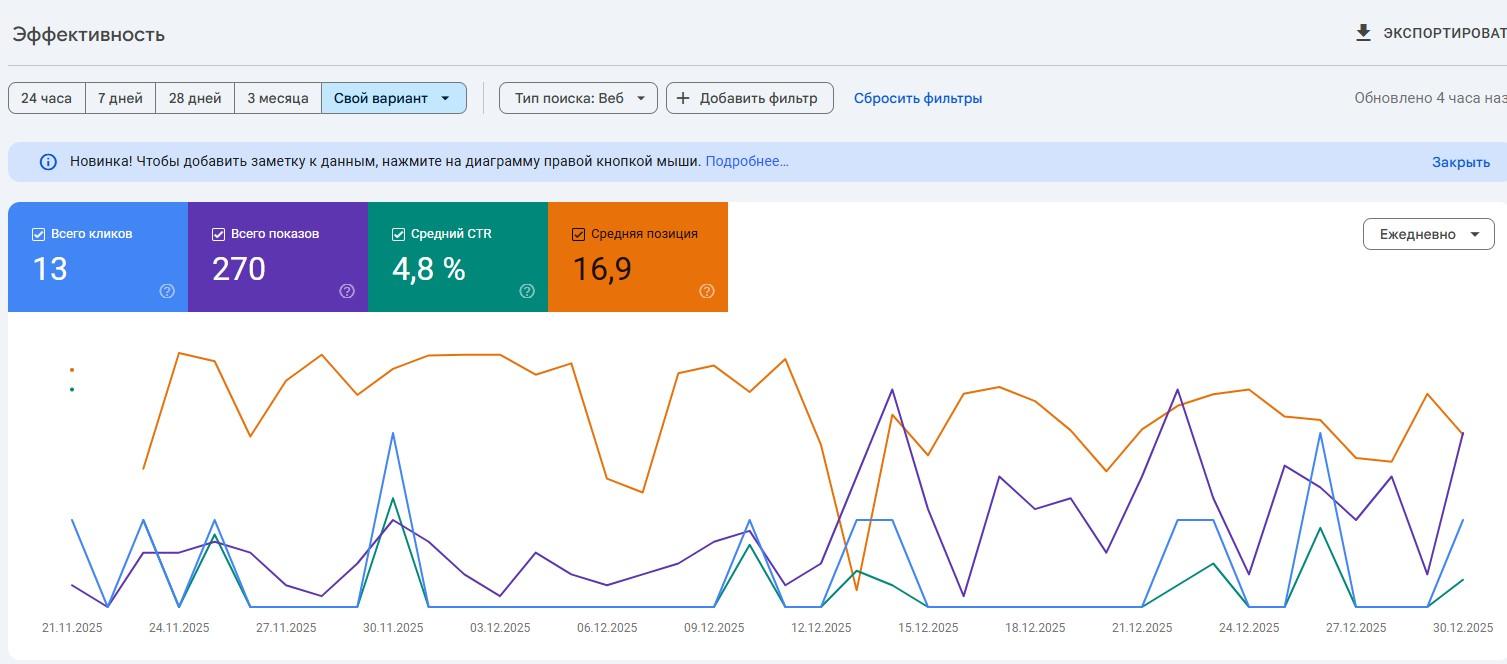
Initial Google Search Console performance (post-launch)
During the first weeks after deployment, the website started generating impressions and organic clicks, indicating successful indexation, crawlability, and baseline relevance across medical search queries.
Exploratory Google Ads Campaigns
To objectively assess international demand for gynecological and surgical medical services, a series of 18 exploratory Google Ads campaigns was designed and launched.
Campaign types:
-
Search campaigns;
-
Google Display Network (GDN) campaigns.
Geographic coverage included:
-
CIS countries;
-
Eastern Europe;
-
Europe;
-
Asia (including Singapore and island regions);
-
India;
-
Israel;
-
North and South America.
Campaign languages:
-
English;
-
Russian.
Primary objectives of these campaigns:
-
identification of real demand for medical services;
-
analysis of search volume and reach across regions;
-
evaluation of cost-per-click (CPC) in different markets;
-
comparison of language-based audience segments;
-
validation of hypotheses prior to scaling SEO and paid acquisition.
In practice, Google Ads was used not only as a lead generation channel, but as a market diagnostics and data-driven strategy tool.
Meta Advertising Campaigns (Facebook and Instagram)
In parallel, advertising campaigns were launched within the Meta ecosystem:
-
Facebook;
-
Instagram.
Campaigns were executed in:
-
Russian;
-
Hebrew.
This enabled:
-
testing of social demand in the medical niche;
-
evaluation of audience response across language segments;
-
collection of engagement and interaction cost metrics;
-
formation of initial remarketing audiences.
Google Business Profile
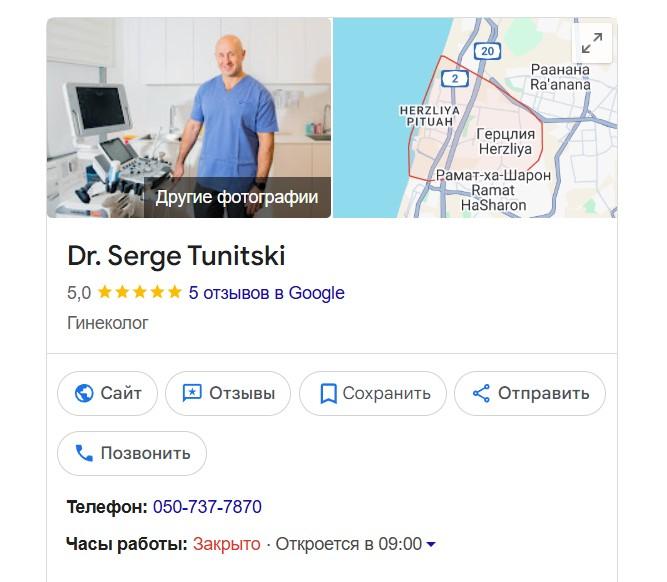
To strengthen local presence and trust signals, a Google Business Profile was created and fully optimized for Dr. Serge Tunitski.
This provides:
-
visibility in Google Maps;
-
increased local relevance;
-
reinforcement of E-E-A-T signals;
-
an additional inbound lead acquisition channel.
Google Business Profile — verified local medical presence
A fully configured and verified Google Business Profile was created for the doctor, ensuring visibility in Google Maps, local search results, and strengthening trust signals (E-E-A-T) for both users and search engines.
Social Media Presence and Brand Ecosystem
As part of the project, official social media channels were created and structured in both Russian and English across the following platforms:
-
Facebook;
-
Instagram;
-
X (Twitter);
-
YouTube;
-
TikTok;
-
Pinterest.
This step establishes:
-
long-term media presence;
-
a foundation for content marketing;
-
additional trust and authority signals;
-
a surrounding ecosystem for the personal medical brand.
Strategic Value of the Market Intelligence Phase
Collectively, this stage made it possible to:
-
transition from assumptions to measurable data;
-
validate or disprove market hypotheses;
-
prepare infrastructure for scalable growth;
-
synchronize SEO, paid advertising, and analytics into a unified system.
10. Reputation Management and Social Proof (Reputation & Trust Signals)
In medical digital projects, patient trust is a decisive factor in the decision-making process, comparable in importance to professional medical expertise. This project included a dedicated reputation and behavioral reinforcement layer aimed at improving conversion rates and aligning with E-E-A-T principles.
MedReviews Integration
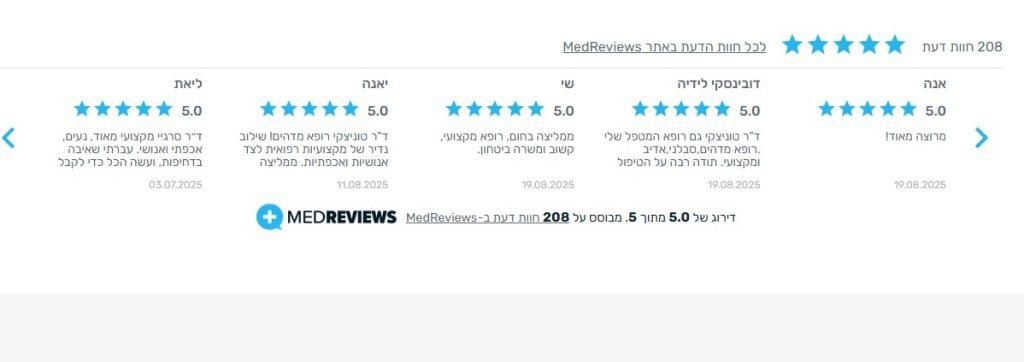
An automated integration of patient reviews from the independent medical platform MedReviews was implemented on the website.
Key parameters:
-
total number of reviews: 208;
-
reviews are sourced from an external authoritative platform;
-
a unified display format is used without content distortion;
-
reviews are embedded directly into patient decision-making flows.
This approach allows the project to:
-
increase trust among new patients;
-
reinforce the physician’s expertise through external validation;
-
reduce psychological barriers to appointment booking;
-
meet Google’s requirements for medical YMYL content.
Strategic Importance of Reputation Management
The integration of external reviews alongside the development of proprietary feedback channels enabled:
-
the creation of a continuous trust chain: external authority → website → appointment booking;
-
reinforcement of medical expertise without declarative or promotional claims;
-
supplementation of SEO and advertising with non-marketing quality signals.
In the medical domain, this layer is not auxiliary but foundational to sustainable digital performance.
11. Overall Conclusions and Project Outcomes
The digital project for gynecologist-surgeon Dr. Serge Tunitski represents a comprehensive and systematic approach to medical marketing, where the website functions not as a service showcase, but as a multi-layered infrastructure of trust, expertise, and conversion.
The project was built at the intersection of:
-
medical expertise;
-
search engineering;
-
UX design;
-
frontend architecture;
-
content and reputation strategy;
-
data-driven advertising validation.
Key Achieved Results
As a result of the full-cycle implementation, the project achieved:
-
a scalable, multilingual medical platform compliant with YMYL and E-E-A-T requirements;
-
a logically structured and deeply clustered website architecture aligned with real patient scenarios;
-
technical and semantic readiness for sustainable organic growth in Google;
-
a solid foundation for international SEO and advertising expansion;
-
seamless integration of reputation signals (MedReviews, Google Business Profile) into the user decision journey;
-
consolidation of website, advertising, analytics, and social channels into a unified digital ecosystem.
Lead Generation Results
At the current stage, the project demonstrates a stable flow of inbound inquiries:
-
an average of 3–6 inquiries per day;
-
inquiries are received through:
-
website appointment forms;
-
WhatsApp;
-
Telegram;
-
email;
-
Google Business Profile.
-
It is important to note that these results were achieved without aggressive advertising scaling, driven instead by:
-
correct digital architecture;
-
trust-oriented UX;
-
medically validated content;
-
SEO readiness and analytical groundwork.
Strategic Value of the Project
The project’s value extends beyond short-term metrics. Its core strength lies in the fact that:
-
a system was built, not isolated tools;
-
the website is ready for future growth without structural redesign;
-
individual medical directions (gynecology, surgery, oncology) can be scaled independently;
-
accumulated data enables fact-based decision-making rather than hypothesis-driven actions.
In effect, a long-term digital platform for a personal medical brand was established — capable of adapting to market changes, search algorithm updates, and evolving user behavior.
Live Website: https://drtunitski.co.il
Final Summary
This case demonstrates that sustainable success in the medical niche is achieved not through isolated tactics, but through an engineered strategy where SEO, content, design, technology, advertising, and reputation operate as a unified system.
Consultation
We respond within 15 minutes
FAQ about Medical Website Development and Promotion
1. Why was a comprehensive approach chosen for a medical project instead of SEO alone?
Medical websites fall under the YMYL (Your Money or Your Life) category, where search engines evaluate not isolated factors, but the combined effect of expertise, trust, user experience, and technical reliability. SEO alone, without proper architecture, UX, content strategy, and reputation signals, cannot deliver sustainable results in this domain.
2. What key Google requirements were considered when working on a medical website?
The project was built around the E-E-A-T principles: Experience, Expertise, Authoritativeness, and Trustworthiness. These principles were reflected in the site structure, strong physician personalization, evidence-based content, verified reviews, and transparent contact and business information.
3. Why was such a deep structure developed for gynecology, surgery, and oncology sections?
A deep and granular hierarchy allows the creation of dedicated landing pages for specific medical queries, symptoms, and diagnoses. This increases topical relevance, reduces keyword competition, and improves conversion rates by accurately matching patient intent.
4. Why was the React + Next.js stack used for a medical website?
Next.js provides server-side rendering and static generation, which are critical for SEO performance and fast page load times. React enabled the implementation of complex interactive components without compromising performance, accessibility, or technical SEO.
5. Why was WordPress chosen as the backend?
WordPress was used as a content management layer. In a headless configuration, it allows physicians and editors to manage medical content independently, without affecting the frontend architecture or the site’s SEO logic.
6. How was multilingual support implemented, and why were three core languages selected?
The platform technically supports seven languages, but English, Hebrew, and Russian were prioritized as the primary languages of the target audience. This approach allowed SEO authority and resources to be focused on the most conversion-driven markets.
7. How was proper indexing and SEO hygiene ensured?
The project includes dynamic meta tags, canonical URLs, hreflang implementation, sitemap.xml, robots.txt, and strict environment separation (development vs production). This prevents duplication, indexing errors, and technical penalties.
8. Why was Schema.org given special attention?
Structured data such as MedicalClinic, Person, Organization, and Article improves search engine trust, enhances content understanding, and increases the likelihood of rich results in search listings.
9. What role did MedReviews play in the project?
208 reviews from an independent medical platform serve as strong social proof. They reduce patient skepticism, reinforce E-E-A-T signals, and directly influence the decision to book an appointment.
10. Why was review collection in Google Business Profile important?
Reviews in Google Business Profile strengthen local SEO, increase visibility in Google Maps, and improve click-through rates. This is especially important for medical services, where decisions are often made quickly and emotionally.
11. Why were exploratory Google Ads campaigns launched?
Google Ads was used as a market intelligence tool to assess real demand, search volume, reach, and cost-per-click across different countries and languages. This enabled data-driven decisions rather than assumptions.
12. What role did Meta (Facebook and Instagram) campaigns play?
Meta campaigns were used to test social demand, collect initial engagement analytics, and build remarketing audiences for future growth.
13. Why were accessibility features and legal blocks implemented on the website?
Accessibility tools, privacy policy, cookie consent, and legal pages increase user trust, ensure compliance with international standards, and positively impact behavioral metrics.
14. How did the project perform in terms of patient inquiries?
At the current stage, the website generates a stable flow of 3 to 6 inbound inquiries per day via website forms, messengers, email, and Google Business Profile—without aggressive advertising.
15. What is the core value of this case study?
The key value lies in building not just a website, but a scalable digital medical platform where technology, SEO, content, analytics, advertising, and reputation operate as a unified system.
Consultation
We respond within 15 minutes


