


How We Designed Case Studies for a Manufacturing Marketing Agency
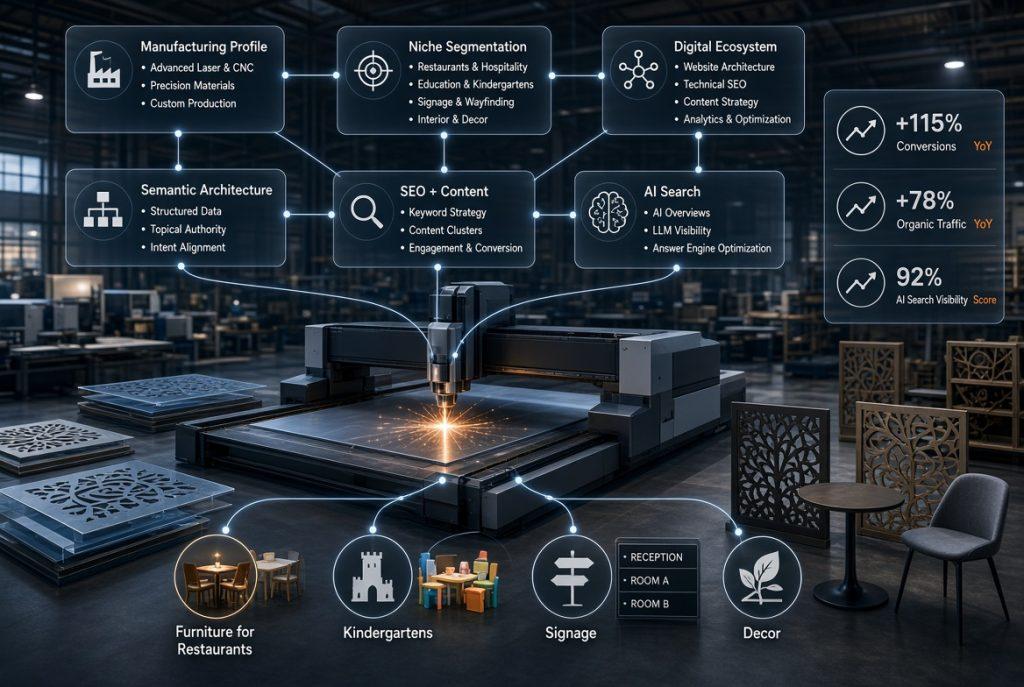
In an earlier article I explained why a standard category system isn’t enough for a manufacturing marketing agency, and how we built a single semantic structure around four spaces: Industrial, Technology, Solutions, and Services.
The next step came from the case studies themselves.
When you’re describing a manufacturing company, a case study can’t be reduced to a few paragraphs like “the client came to us, we built a website, launched SEO and ads, traffic went up.” That’s too shallow for manufacturing.
A manufacturing business can produce dozens of product groups at once, work with different materials, use different technologies, and serve completely different markets. Digital marketing for a business like that isn’t one service either.
So we approached the case study not as a portfolio page, but as a structured model of a real project.
I’ll walk through the structure using Laser Made as the running example. This is a manufacturer we worked with for five years, and it shows clearly why a standard case study template falls short.
Consultation
We respond within 15 minutes
1. Why the Standard Case Study Structure Isn’t Enough
A typical corporate case study looks something like this: Client, Challenge, Solution, Results, Testimonial. For an ordinary digital project, that might be enough. A manufacturing project is built differently.
Laser Made started as a laser and CNC cutting shop. Physically, it’s one production floor with shared equipment. Commercially, though, several separate businesses were operating inside it.
There was custom furniture: tables, chairs, cabinets, wardrobes, made-to-measure pieces for full apartment fit-outs. There was furniture for commercial and public spaces: restaurants, cafes, kindergartens. There was signage: billboards, light boxes, small plaques. And there was decor: laser-cut acrylic panels made for retail stores, cafes, and presentation displays.
The equipment and production processes overlapped across all of these. The markets, search queries, landing pages, and ad campaigns almost never did.
So the question for the case study becomes not just “what did we do,” but:
- What does this manufacturing business actually consist of?
- What commercial directions exist inside it?
- How does the production connect to products, materials, applications, and markets?
- How was that structure translated into a digital presence?
Only after answering those questions does it make sense to ask how the marketing worked on top of it.
2. A Case Study Describes More Than Marketing
While designing the structure, we split the information into several layers. First comes the production itself. Second, the business problem. Third, commercial segmentation. Fourth, digital architecture. Fifth, marketing strategy. Sixth, AI search. Seventh, process and results.
The result is a sequential model rather than a narrative. Production leads into the business, the business into commercial segmentation, that into digital architecture, marketing, and results. It’s much closer to how a real manufacturing engagement actually unfolds.
3. Manufacturing Profile: Understanding What the Company Actually Makes
The first major group in the structure is manufacturingProfile. It contains four fields: productionCapabilities, products, materials, applications.
We didn’t build a separate taxonomy for each of these, because they serve a different purpose. Categories describe semantic relationships across the whole site. Manufacturing Profile explains the specific client in a specific case study. That’s why the information here is descriptive rather than a reference list.
Production Capabilities. This isn’t just a list of equipment. It covers production operations, material processing, cutting, milling, welding, bending, coating, assembly, installation, and whether the production cycle is full or partial. The field’s job is to give the reader a real sense of the factory’s capacity.
Products. The actual output of the client, not the agency’s marketing services and not site categories. For Laser Made, that meant custom cabinet furniture, furniture for HoReCa and childcare facilities, signage structures, and decorative cut elements.
Materials. Materials carry their own weight and are often part of the production specialization: metal, steel, aluminum, wood, MDF, acrylic, plastics, composites.
Applications. Where the products are actually used: construction, facades, retail, HoReCa, industry, medical equipment, interiors, advertising.
Even inside one Manufacturing Profile, a small semantic space forms: capabilities connect to products, products to materials, materials to applications.
4. Why We Didn’t Add Technologies to the Manufacturing Profile
It might seem logical to add a technologies field here too. We deliberately didn’t.
The project already has a Case Study Categories system built around four spaces: Industrial, Technology, Solutions, Services. Technologies are part of that shared semantic system. Adding a separate text field would mean storing the same information in two places, which breaks the Single Source of Truth principle.
If a technology matters to the case, it’s represented through the existing category structure. The specific production process can still be described in detail inside productionCapabilities.
A category handles the semantic connection. Rich text handles the detailed explanation. These are two different layers of information.
5. Business Challenge: What the Situation Looked Like Before
The next group is businessChallenge, made up of three parts: initialState, challenge, goals.
That split turned out to matter, because these are three genuinely different things.
Initial State describes the starting situation. At Laser Made, that meant a couple of basic landing pages and no structure that reflected the different production directions.
Challenge describes the actual problem. The production exists and has real capacity, but the market and search engines don’t see those directions as separate commercial entities. Someone looking for kindergarten furniture and someone looking for a light box sign are in completely different markets, even though the same workshop fulfills both orders.
Goals describes what the project was meant to achieve.
Together they form a straightforward chain: what was there, what was in the way, what the client wanted to reach.
6. Niche Segmentation: One Factory Can Be Several Businesses
This is one of the most important parts of the structure. We made nicheSegmentation a repeatable group, because a single manufacturer can run several commercial directions at once.
For Laser Made, that looked like this. Made-to-order furniture for full apartment fit-outs. Furniture for restaurants and cafes. Furniture for kindergartens and public institutions. Signage structures. Decorative laser-cut elements.
Physically, it’s one workshop. Commercially, it’s several distinct markets, each with its own audience, its own arguments, and its own demand pattern. A separate landing page and a separate search campaign were built for each direction.
For every niche, we store name, description, and marketingApproach. The important part is not repeating the entire production profile inside each one. We don’t add separate products, materials, applications, technologies, or categories per niche, or the same information would start multiplying across the case.
A niche answers a different question: how does an existing production capability turn into a distinct commercial direction?
7. Why This Model Fits Manufacturing So Well
At Laser Made, laser cutting was one shared technology. The commercial pages built on top of it were completely different: signage, furniture, decorative elements, custom orders.
One production capability creates several market directions. That’s exactly why manufacturing marketing can’t be reduced to “service, page, keyword.” You need to see the chain from production capability to product, to application, to market, to commercial niche.
8. Digital Ecosystem: Translating Production Into a Digital Presence
After the business layer comes digitalEcosystem. This isn’t just the website. It includes the main corporate site, landing pages, analytics, CRM, advertising platforms, messaging channels, and other digital touchpoints.
At Laser Made, part of that ecosystem was a separate store called Decor Trend. The decor direction needed a different sales logic than made-to-order furniture, so it was spun off into its own project.
The next layer is websiteArchitecture: page structure, URL architecture, landing pages, navigation, content hierarchy, and how sections connect to each other.
Then semanticArchitecture, a deeper layer describing semantic clusters, entities, content hubs, and internal relationships between products, technologies, applications, services, and commercial directions.
The sequence runs: business structure, then site architecture, then semantic architecture.
9. SEO as a System, Not a List of Technical Tasks
In the old model, a case study could simply say “we performed SEO optimization.” For manufacturing, that’s not enough.
In our structure, SEO merges with content and semantics in a single field, seoAndContentStrategy. It covers semantic research, keyword mapping, content clusters, landing pages, technical SEO, internal linking, expert content, and content hubs.
SEO here is described as a system for representing the manufacturing business inside the search environment, not as a checklist of tasks.
10. Paid Advertising and Social Media: Separate Layers
SEO and PPC don’t work the same way, so paidAdvertising is a separate repeatable group. For each channel, we capture channel, strategy, campaign structure, and results. If another channel was used, it gets added as its own item. This lets one case study describe a genuine multi-channel strategy instead of forcing everything into a single block of text.
socialMedia follows the same pattern: strategy, content, and results for each channel that was actually used.
One rule applies to both: if the company used LinkedIn and YouTube, they belong in the case. If TikTok was never used, it doesn’t get invented. A case study describes the project, not an idealized marketing plan.
11. Lead Generation: Traffic Isn’t the Goal by Itself
Another important field is leadGenMechanism.
SEO and advertising generate traffic, but for B2B manufacturing, traffic is only an intermediate step. The real chain usually looks like this: a search leads to a landing page, the visitor gets product and application information, technical trust builds up, and only then comes a quote request, a form submission, a message, or a call.
So the case study needs to show not just that visits went up, but how a visitor turned into a commercial inquiry.
12. AI Search: A New Layer of the Case Study
The search landscape has changed. Information about a company today gets used not only by Google, but by ChatGPT, Perplexity, Gemini, and other AI systems.
That’s why the structure includes aiSearchOptimization, limited to two blocks.
brandAuthorityAndTrust covers expertise, authorship, publications, reviews, external mentions, reputation, and E-E-A-T-related signals.
entityAndGeoStructure describes how clearly the company is represented as an entity: the company itself, its products, technologies, applications, markets, services, locations, experts, and the external sources that confirm it.
These fields earn their value at the next step, when the structured information turns into actual content: pages, internal links, structured data, expert material, and external mentions that both Google and AI search systems can read. That’s why we design these fields alongside the rest of the case study rather than in isolation. They draw from the same body of data that builds the page, and that page is what search and AI systems eventually read as a single, coherent story about the company.
13. Process and Timeline: Showing the Path, Not Just the Outcome
The implementationProcess field shows what was done and in what order: research, semantic analysis, architecture, landing pages, SEO, PPC, content, optimization, lead generation work.
The same rule of factual accuracy applies here. If a stage didn’t happen in the real project, it doesn’t get added just because it reads well in a case study.
timeline shows how the project evolved over time: period, title, description. This matters especially for long manufacturing engagements. Five years of work with Laser Made can’t be reasonably summarized as “we built a website and ran ads.” Over that time, the site structure changed, the semantic core grew, the number of directions changed, and so did the advertising strategy and the content.
14. Results and Projects Showcase: Numbers and Physical Proof
The case study includes resultsSummary and metrics. Each metric has three parts: value, label, description.
The core rule here: two real metrics are worth more than ten invented ones. If a project has real data on traffic, rankings, conversions, or leads, it gets shown. If the data doesn’t exist, it doesn’t get created.
projectsShowcase matters on its own. A manufacturing client wants to see more than a traffic chart. They want to see what the company actually produced and which projects were shown to the market. This is where real products, objects, photos, and links go. It connects the digital case study to the physical output of the factory.
15. Expert Insight: The Most Valuable Part of the Case
We kept a separate field for expertInsight. This isn’t the place for “we achieved a great result through a comprehensive approach.” It’s meant to hold an actual professional conclusion.
For example: a manufacturing business can’t be promoted through one generic page if the company runs several independent commercial directions. Or: a technology can be shared across several markets, but the pages and search semantics need to reflect each application separately.
Conclusions like these turn a case study from a report on completed work into a piece of expert material.
Why We Didn’t Build Related Cases or a Second FAQ
Two decisions worth explaining.
We deliberately skipped a manual relatedCases field. A manual link looks convenient at first, but it creates another layer of data that someone has to maintain by hand. Case studies are already connected through the shared category system. When two cases share categories, the connection exists because the projects genuinely sit in the same semantic space, not because an editor once checked a box labeled “related case.”
The same logic applies to Q&A. The CMS already has an FAQ module. Building a second set of questions and answers inside the case study doesn’t add anything. One type of information gets one place to live.
CMS and Frontend Solve Different Problems
While designing the structure, we didn’t design the visual components at the same time. The CMS handles data structure. The frontend handles how that data gets presented.
That separation gives us freedom. The same dataset can become a case study page, a portfolio card, a category page, a curated selection of projects, a LinkedIn carousel, or a PDF.
The structure still didn’t turn into a forty-field questionnaire. On the frontend, the groups collapse into a handful of visual sections: manufacturing profile, business challenge, commercial directions, digital architecture, marketing, AI search, process, results, projects, expert insight.
A properly designed CMS stops being just the site’s admin panel. It becomes a structured source of content.
The Case Study as Proof of Competence
Manufacturing companies are almost always more complex on the inside than they look from the outside. Several technologies, dozens of products, different materials, many applications, several industries and countries, different commercial directions, different advertising channels.
Store all of that in one large text field and the structure disappears. Build a separate taxonomy for every concept and the system becomes overloaded. What’s needed is a balance: structured relationships where relationships genuinely matter, and rich text where the work calls for human, expert-level explanation.
For a manufacturing marketing agency, a case study shouldn’t just prove that you can build websites. It should show that you understand production, that you can break a complex manufacturing business down into commercial directions, translate that structure into a digital architecture, connect semantics, content, advertising, and lead generation, and demonstrate a measurable result.
A good case study doesn’t just answer “what did you do.” It shows how the manufacturing business was structured, what the commercial problem actually was, how that business became a digital architecture, what changed, and what another manufacturing company could take away from the project.
Maryan Polyak
Web Developer | SEO & AI Search Optimization | Digital Marketing
Manufacturing & Industrial Marketing
Consultation
We respond within 15 minutes


